Exact variant status
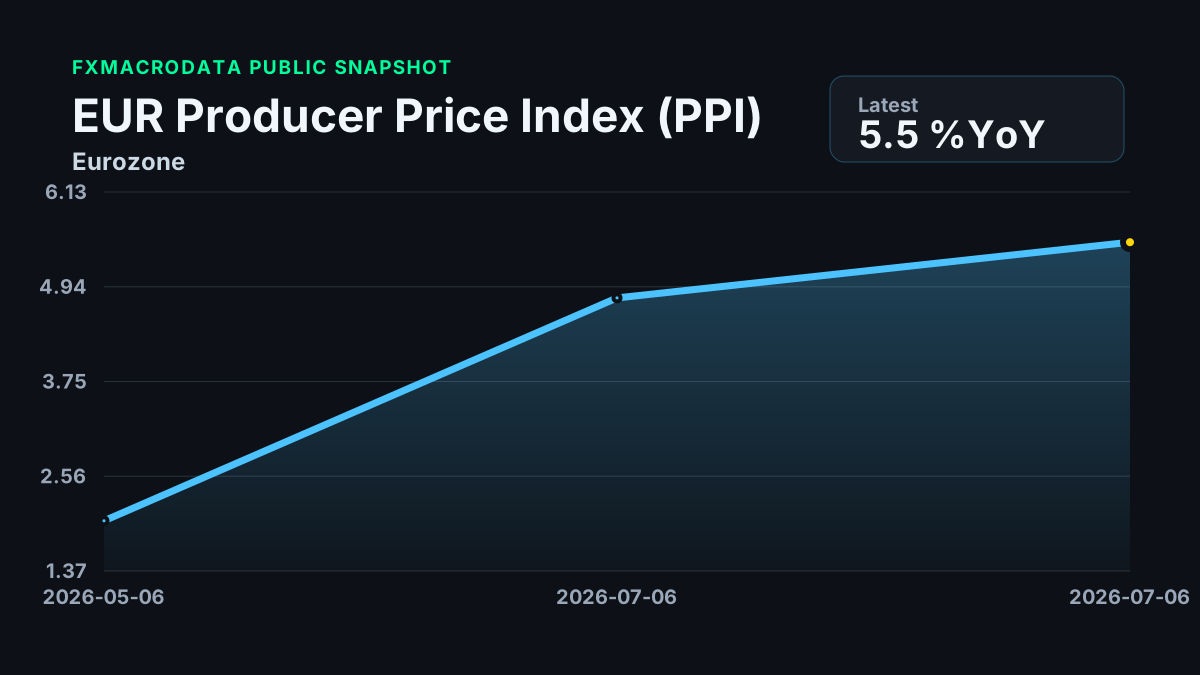
Query resolved as EUR PPI YOY. Status: Exact official coverage.
Closest official alternatives are listed below so searches for unsupported variants still resolve to useful, published data.
Eurozone inflation coverage across CPI, core, PCE, PPI, expectations, components, release calendars, recent announcements, and API access. Use this page to check the selected series, compare nearby measures, and move directly into the versioned endpoint.
Query resolved as EUR PPI YOY. Status: Exact official coverage.
Closest official alternatives are listed below so searches for unsupported variants still resolve to useful, published data.
Source: Eurostat. Cadence: Monthly. Unit: %YoY. History from 2001-01-01 (25.6 years).
2026-08-05
Prior release value for the selected series.
Latest move versus the previous published reading.
4 release rows.
Release rows link into the inflation workspace and expose actual, previous, forecast, and reference-period context.
| Release time | Reference | Actual | Previous | Forecast | Detail |
|---|---|---|---|---|---|
|
2026-08-05 09:00 UTC
|
2026-06-01 | 4.4 | 5.5 | -- | Release page |
|
2026-07-06 11:00 UTC
|
2026-04-01 | 4.8 | 2 | -- | Release page |
|
2026-07-06 09:00 UTC
|
2026-05-01 | 5.5 | 4.8 | -- | Release page |
|
2026-05-06 11:00 UTC
|
2026-03-01 | 2 | -- | -- | Release page |
Endpoint coverage and contract for the official inflation series used by this workspace.
This page documents request inputs, response fields, access model, provenance, and the published history window for
/api/v1/announcements/eur/ppi.
Currently documented history runs from 2001-01-01 to 2026-06-01 for this endpoint.
Production OpenAPI schema: https://api.fxmacrodata.com/openapi.json
Responses expose source, source_url, provenance, data_quality, announcement_id, and announcement_datetime fields.
Optional indicators use per-currency capability checks and may be temporarily hidden while source coverage is being remediated.
foreign_reservescb_assetsinflation_mom| Parameter | Required | Type | Description |
|---|---|---|---|
currency |
YES | string |
3-letter currency code. |
indicator |
YES | string |
Indicator slug. Use /v1/data_catalogue/{currency} to list available slugs per currency. |
| Parameter | Required | Type | Description |
|---|---|---|---|
start_date |
NO | string (YYYY-MM-DD) |
Earliest observation date to include. Date filters are applied before pagination. Authenticated requests page through full stored history when omitted; anonymous USD requests are limited to the most recent 365 days and 100 no-key requests/day. |
end_date |
NO | string (YYYY-MM-DD) |
Latest observation date to include. Defaults to today. |
limit |
NO | integer |
Maximum number of most-recent-first rows to return per page. Defaults to 20; maximum 100. |
page |
NO | integer |
One-based page number. When supplied, page takes precedence over offset; page=2 with limit=20 is equivalent to offset=20. |
offset |
NO | integer |
Zero-based row offset after date filtering. Use with pagination.next_offset to request the next page. |
api_key |
YES | string |
Professional API key. Required for non-USD currencies and for USD requests that need history older than 365 days. |
| Field | Type | Description |
|---|---|---|
currency |
string |
3-letter currency code. |
indicator |
string |
Indicator slug as requested. |
has_official_forecast |
boolean |
True if the central bank publishes an official forecast for this indicator. |
start_date |
string |
Earliest date in the filtered result set (YYYY-MM-DD). |
end_date |
string |
Latest date in the filtered result set (YYYY-MM-DD). |
earliest_available_date |
string | null |
Earliest date available for this series before any date filter or pagination is applied. |
latest_available_date |
string | null |
Latest date available for this series before pagination is applied. |
requested_start_date |
string |
Start date applied to the request after endpoint defaults are resolved. |
requested_end_date |
string |
End date applied to the request after endpoint defaults are resolved. |
requested_window_has_data |
boolean |
False when the endpoint returned the latest eligible observation before the requested window instead of an observation inside the requested date range. |
page_includes_latest_available |
boolean |
True when the current page includes latest_available_date. False usually means the latest row is on a different page or the response is a historical page. |
pagination.limit |
integer |
Page size used for this response. |
pagination.offset |
integer |
Zero-based offset used for this response. |
pagination.returned_count |
integer |
Number of rows included in data[]. |
pagination.total_count |
integer |
Total number of rows matching the path and date filters before pagination. |
pagination.has_more |
boolean |
True when another page is available. |
pagination.next_offset |
integer | null |
Offset to use for the next page, or null when there are no more rows. |
pagination.page_includes_latest_available |
boolean |
Mirrors page_includes_latest_available inside the pagination envelope for clients that keep pagination state together. |
cb_target |
object | null |
Central bank target metadata (e.g. inflation target range), if applicable. |
data[].date |
string |
Observation date (YYYY-MM-DD). |
data[].announcement_id |
string |
Stable announcement identifier in the form `{currency}_{indicator}_{date}` — use it to join predictions from /v1/predictions/{currency}/{indicator} and revision history. |
data[].val |
number | null |
Observed value in the indicator's native unit. |
data[].announcement_datetime |
integer | null |
Unix timestamp (UTC) of the official data release. |
data[].pct_change |
number | null |
Period-over-period percentage change. |
data[].pct_change_12m |
number | null |
12-month rolling percentage change. |
data_quality |
object |
Standardized endpoint-level quality, source, freshness, and point-in-time safety metadata for the returned payload. |
data_quality.is_official |
boolean |
True when the response is backed by an official source and is not proxy, fallback, derived, or prohibited-source data. |
data_quality.is_proxy |
boolean |
True when the response is an explicit proxy for the requested concept rather than the primary official series. |
data_quality.is_fallback |
boolean |
True when one or more returned rows are marked as fallback data. |
data_quality.is_stale |
boolean |
True when the newest available observation is older than the endpoint's frequency-aware stale_after_days threshold. |
data_quality.has_announcement_datetime |
boolean |
True when all rows in the quality scope carry the required announcement timestamp field or fields. |
data_quality.point_in_time_safe |
boolean |
True when the result is not fallback/prohibited data and has complete release timestamps for point-in-time workflows. |
data_quality.latest_available_date |
string | null |
Freshest observation date available for the quality scope before pagination-specific caveats. |
data_quality.last_updated |
string | null |
Server-side refresh or update timestamp when the endpoint has one available. |
data_quality.data_lag_days |
integer | null |
Calendar-day lag between today and latest_available_date; null when the latest date is missing, invalid, or future-dated. |
data_quality.source_name |
string | null |
Human-readable source or publisher label used for the response. |
data_quality.source_type |
official | public | fallback | derived |
Normalized source classification shared across source-backed REST and MCP responses. |
data_quality.is_derived |
boolean |
True when the endpoint output is calculated from underlying source rows, such as spreads, slopes, forward curves, forecasts, or sentiment composites. |
data_quality.row_count |
integer |
Number of rows considered in the data-quality scope. |
data_quality.announcement_datetime_count |
integer |
Number of rows in scope with complete required announcement timestamp fields. |
data_quality.missing_announcement_datetime_count |
integer |
Number of rows in scope missing at least one required announcement timestamp field. |
data_quality.quality_scope |
string |
Scope used to compute the quality object, such as full_result, latest, recent, or scheduled_releases. |
data_quality.stale_after_days |
integer | null |
Frequency-aware threshold used for is_stale; daily=7, weekly=21, monthly=62, quarterly=125, annual=550 by default. |
source |
string |
Human-readable upstream publisher or source family for this response. |
source_url |
string | null |
Official publisher URL or source landing page when available. |
provenance |
object |
Structured provenance metadata including publisher, storage layer, served_by, timestamp field, and value field. |
source_series_name |
string | null |
Publisher's source-series label when FXMacroData stores one. |
source_local_name |
string | null |
Local-language or publisher-native series name when available. |
provenance.publisher |
string |
Official upstream publisher for the requested currency/indicator series. |
provenance.storage |
string |
FXMacroData serving storage layer for the returned payload. |
import requests

url = "https://api.fxmacrodata.com/v1/announcements/eur/ppi"
params = {
    "start_date": "2023-01-01",
    "end_date": "2023-12-31",
    "limit": "20",
    "page": "1",
    "api_key": "YOUR_API_KEY",
}
response = requests.get(url, params=params, timeout=20)
response.raise_for_status()
payload = response.json()

print(payload.get("data", payload)){
"currency": "EUR",
"indicator": "ppi",
"has_official_forecast": false,
"requested_start_date": "2001-01-01",
"requested_end_date": "2026-06-01",
"requested_window_has_data": true,
"page_includes_latest_available": true,
"start_date": "2001-01-01",
"end_date": "2026-06-01",
"earliest_available_date": "2001-01-01",
"latest_available_date": "2026-06-01",
"pagination": {
"limit": 20,
"offset": 0,
"returned_count": 1,
"total_count": 1,
"has_more": false,
"next_offset": null,
"page_includes_latest_available": true
},
"cb_target": null,
"source": "Eurostat",
"source_url": "",
"source_series_name": null,
"source_local_name": null,
"provenance": {
"publisher": "Eurostat",
"publisher_url": null,
"storage": "FXMacroData production dataset",
"served_by": "FXMacroData API",
"timestamp_field": "announcement_datetime",
"value_field": "val"
},
"data_quality": {
"is_official": true,
"is_proxy": false,
"is_fallback": false,
"is_stale": false,
"has_announcement_datetime": true,
"point_in_time_safe": true,
"latest_available_date": "2026-06-01",
"last_updated": null,
"data_lag_days": null,
"source_name": "Eurostat",
"source_type": "official",
"is_derived": false,
"row_count": 1,
"announcement_datetime_count": 1,
"missing_announcement_datetime_count": 0,
"quality_scope": "full_result",
"stale_after_days": null,
"requested_window_has_data": true,
"page_includes_latest_available": true
},
"data": [
{
"date": "2026-06-01",
"announcement_id": "eur_ppi_2026-06-01",
"val": 4.2,
"announcement_datetime": 1722456000,
"pct_change": null,
"pct_change_12m": null
}
]
}Release alerts
Enter your account email. We will notify you when the next official-source EUR Producer Price Index (PPI) release is published.
CPI, PCE, PPI, core, real/nominal, and market-implied measures for this country, with explicit availability state.
Month-over-month CPI inflation where the official source publishes or the API carries that field.
Quarter-over-quarter CPI inflation, common for countries that publish quarterly CPI.
Year-over-year CPI inflation, normally the headline inflation rate users search for.
Headline consumer price inflation from the official national CPI release.
Core CPI, usually excluding food and energy or the local official equivalent.
Year-over-year core CPI inflation, the most common core consumer-price variant.
Core PCE inflation, typically excluding food and energy when an official series exists.
HICP inflation, mainly used for EU and euro-area comparable consumer price data.
Personal Consumption Expenditures price inflation where the country publishes a PCE-style series.
Export price inflation, useful for terms-of-trade and commodity-linked currency analysis.
Import price inflation, useful for FX pass-through and traded-goods inflation analysis.
Market-implied inflation compensation from nominal and inflation-linked bonds.
Survey, market, or official inflation expectations where published in the catalogue.
Broad price inflation across domestically produced output where available.
Month-over-month producer price inflation when available from the official source.
Year-over-year producer price inflation.
Producer price inflation, often used as an upstream inflation-pressure indicator.
Sector destinations for food, energy, shelter, goods, services, and other component inflation searches.
| Component | State | Destination |
|---|---|---|
| Food inflation | Destination | Open component |
| Energy inflation | Destination | Open component |
| Shelter inflation | Destination | Open component |
| Goods inflation | Destination | Open component |
| Services inflation | Destination | Open component |
| Transport inflation | Destination | Open component |
| Health inflation | Destination | Open component |
| Education inflation | Destination | Open component |
| Clothing inflation | Destination | Open component |
| Recreation inflation | Destination | Open component |
Food and non-alcoholic beverages, or the closest official food CPI component.
Energy, fuel, electricity, gas, or the closest official energy CPI component.
Shelter, rent, owners' equivalent rent, housing services, or the closest local equivalent.
Goods inflation, including durables and non-durables where the country publishes the split.
Services inflation, often watched for wage-sensitive and persistent price pressure.
Transport services, vehicle costs, fuel pass-through, or the closest official transport component.
Health care and medical price components where published.
Education price components where published.
Clothing and footwear price components where published.
Recreation, culture, and leisure price components where published.