
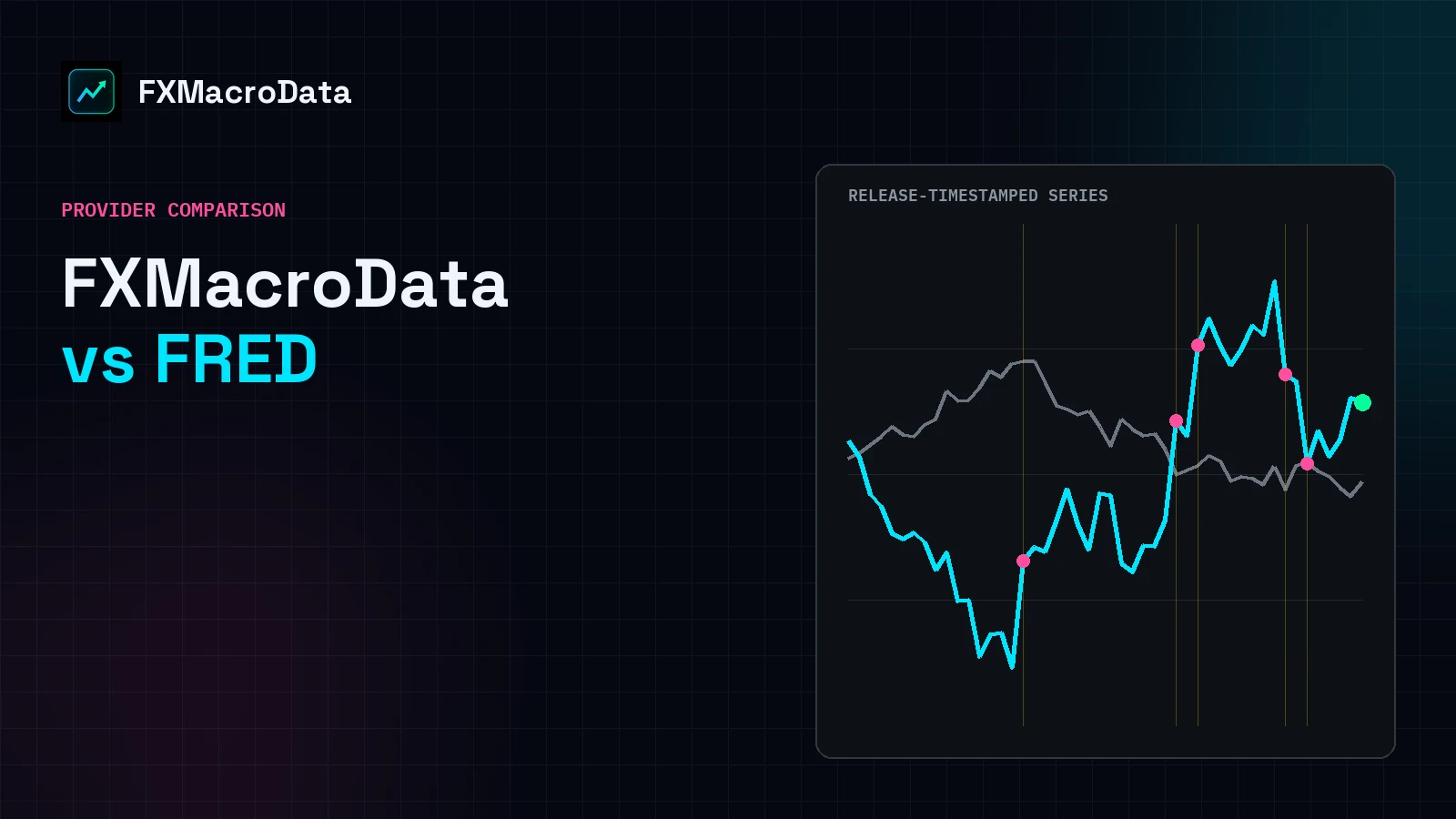
If you are an FX trader, quant developer, or macro analyst choosing between data providers, this comparison is built for that decision. FRED is one of the most trusted free macro data libraries in the world; FXMacroData is a specialist API built for FX workflows. The core result is simple: FRED is unbeatable on price and US macro depth, while FXMacroData is stronger for FX-specific coverage, release-timing precision, and real-time event workflows across major currencies.
Core Finding
FRED is free and excellent for US macro research. FXMacroData costs $50/month but provides a purpose-built FX macro stack: multi-currency indicator coverage, second-level announcement timestamps, release-calendar workflows, and release data typically available within seconds of official publication for event-driven trading.
Side-by-Side Comparison
| Attribute | FXMacroData | FRED |
|---|---|---|
| Entry-level API price | $50/month | $0/month (free; API key required)* |
| Coverage scope | FX macro-first coverage across 22 currencies and FX-linked datasets | Massive macro library centered on US and global economic series |
| API design for FX workflows | Consistent FX-focused endpoints with uniform response shape | Series-centric API model optimized for broad macro lookup |
| Announcement speed and timestamp precision | Typically within seconds of official publication with second-level announcement_datetime |
Observations include date plus vintage fields (realtime_start/realtime_end), but no unified second-level release timestamp standard |
| Rate-limit posture | 1,000,000 requests/month on Individual and Business plans; Always Free tier covers USD at 100 requests/day | Free API key required; no official numeric rate limit is stated on the public API pages, and use is governed by the FRED API Terms of Use |
| Best fit | FX traders, macro quants, event-driven strategy builders | Researchers, students, and US macro analysts needing a free dataset |
* Competitor pricing retrieved from their public pricing page in October 2026.
Pricing: Free vs Purpose-Built
Price Difference Up Front
FRED is free, which makes it a great starting point. FXMacroData has an Always Free USD tier (100 requests/day, USD releases delayed 15 minutes) and charges $50/month for the Individual plan ($250/month for the Business plan for teams of up to 10) because it is designed around live FX-macro execution needs: curated cross-currency indicators, release-calendar scheduling, second-level announcement timestamps, and production-ready endpoint consistency.
If your workload is educational research or occasional series pulls, FRED's price point is unbeatable. If your workload is an always-on FX pipeline that reacts to releases and tracks multiple currencies, the cost of engineering around missing FX-specific workflows can exceed the subscription cost quickly.
Coverage Scope: Breadth vs FX Focus
FRED's core strength is breadth and trust. It aggregates a large macroeconomic universe and is deeply embedded in economics education and policy research. For US macro context and long history series, it is often the first stop.
FXMacroData optimizes for a narrower but different job: the indicators and release structure most relevant to currency trading. That includes rate decisions, inflation variants, labor data, trade balances, release calendars, and related FX datasets in one model. For an FX desk, this reduces mapping overhead and keeps data operations focused.
API Design: Series Lookup vs Workflow-Oriented Endpoints
FRED's API is series-centric: you identify a series and fetch observations. It is flexible and powerful for exploratory work.
FXMacroData's API is workflow-centric for FX teams. Example indicator docs like USD policy rate and EUR inflation follow a consistent endpoint structure, so the same client logic can be reused across currencies and indicators.
To check the endpoint shape against a FRED series pull, this is the US CPI request, returning dated values with announcement timestamps:
curl -H "X-API-Key: YOUR_API_KEY" "https://api.fxmacrodata.com/v1/announcements/usd/inflation"Real-Time Availability and Announcement Precision
For event trading, knowing exactly when a release arrived matters for backtests and alert systems. FXMacroData exposes second-level announcement_datetime values, and releases are typically available within seconds of official publication, measured publicly.
FRED observations document the period date and revision windows (realtime_start / realtime_end), which is excellent for vintage analysis. But FRED does not provide a universal, second-level announcement timestamp layer across FX releases in the same way event-driven FX systems typically require.
Why this matters in practice
- Backtests avoid day-level timing bias when release timestamps are second-accurate.
- Live alerting can trigger at release-time granularity across currencies.
- Cross-country event studies are easier when timestamps share one schema.
US CPI print: FRED series update vs FXMacroData release row
1. BLS publishes CPI
The US CPI report goes out at 8:30 a.m. Eastern; USD/JPY and EUR/USD reprice in the first seconds.
2. FRED observation
The CPI series gains a new observation keyed by period date, with realtime_start / realtime_end vintage fields; there is no second-level release timestamp.
3. FXMacroData row
/v1/announcements/usd/inflation gains a row with a second-level announcement_datetime, typically within seconds of publication, also reachable over SSE and MCP.
4. Decision point
Vintage and revision research fits FRED at no cost. A backtest or alert keyed to the CPI second fits FXMacroData.
Takeaway: FRED records which CPI value was known on which day; FXMacroData records the second it was published, which is what an FX reaction window needs.
Recommendation and Verdict
Choose FRED if your top priority is zero cost and trusted macro research depth, especially for US-focused studies.
Choose FXMacroData if your top priority is FX execution workflow: multi-currency macro coverage, event-ready announcement timing, and API consistency built for trading systems.
For most developer-led FX workflows, FXMacroData is the better operational fit despite the monthly fee. You can review plans on /subscribe, connect AI assistants through the FXMacroData MCP server, and explore endpoint patterns through docs such as GBP policy rate and JPY inflation.
