Release time
2026-11-20 07:00 UTC
- Reference
- 2026-09-30
- Actual
- 814.156
- Previous
- 803.169
- Forecast
- 803.59 FXMacroData Blended Forecast
- Source published
- UTC5,309 ms after the scheduled time
- On FXMacroData
- UTC
- Latency
- Within 5,670 ms

Denmark's Gross Domestic Product (GDP) measures the total value of all goods and services produced by the economy, released quarterly. It is the broadest single gauge of economic health and is closely tracked by the Danmarks Nationalbank when setting monetary policy.
In Q3 2026 (2026-09-30)
Previous 803.169 DKK bn (+1.4%)
785.309 DKK bn on Sep 30, 2025 (+3.7%)
40 readings since 2016; latest +157.31 DKK bn vs average
Published 2026-11-20 07:00 UTC
Time to be confirmed by the publisher
vs FXMacroData model estimate 803.59 DKK bn
Unchanged since first published. History starts 2000-03-31
Denmark / Growth
Denmark's aggregate performance can differ sharply from domestic demand because a few large internationally active firms contribute substantially to recorded output. The OECD's January 2026 survey describes a two-speed economy, with pharmaceutical...
How This Economy WorksNo published studies match this topic.
Release alerts
Enter your account email. We will notify you when the next official-source DKK Gross Domestic Product (GDP) release is published.
Watch a 30-second Short on every major release: subscribe on YouTube
GDP is a primary driver of central bank rate decisions—strong growth raises the probability of tighter monetary policy, which tends to support the dkk. Divergences in growth between two economies are a core foundation of FX fundamental analysis.
A print above consensus suggests the Denmark economy is expanding faster than expected, which is broadly positive for the dkk. A miss can fuel rate-cut expectations and weaken the currency. Revisions to prior quarters can be as market-moving as the headline release.
Check the publisher's unit, reference period and seasonal adjustment. Understand economic measurement terms before comparing this series with another country's measure.
Gross Domestic Product measures the total value of goods and services produced inside a country, usually reported quarterly. It is the broadest available measure of economic activity, and its change over time is the economy's growth rate.
Depending on the country, the headline GDP series is a level (real or nominal, in local currency) or a growth rate (quarter-over-quarter, sometimes annualised, or year-over-year); the unit shows which. Compare currencies on the same definition where possible. Use this table alongside retail_sales, industrial_production, and PMI for a higher-frequency read on the same growth picture.
Source: Statistics Denmark. Cadence: Quarterly. Unit: DKK bn. History from 2000-03-31 (26.6 years).
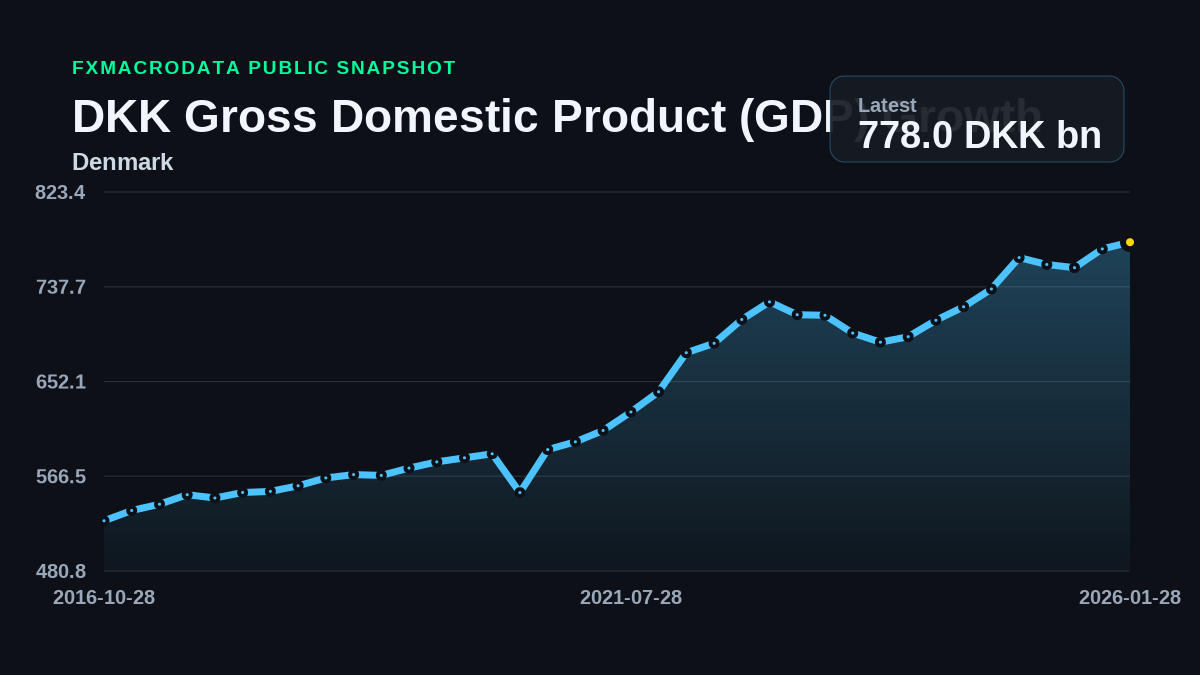
Each release with its reference period, actual, previous and forecast figures.
| Release time | Reference period | Actual | Previous | Forecast | Source published | On FXMacroData | Latency | Detail |
|---|---|---|---|---|---|---|---|---|
|
2026-11-20 07:00 UTC
|
814.156 | 803.169 |
803.59
FXMacroData Blended Forecast
|
UTC
5,309 ms after the scheduled time
|
UTC | 5,670 ms | Announcement page | |
|
2026-08-20 06:00 UTC
|
803.169 | 788.317 | -- | Announcement page | ||||
|
2026-05-20 06:00 UTC
|
788.317 | 789.726 | -- | Announcement page | ||||
|
2026-02-20 07:00 UTC
|
789.726 | 785.309 | -- | Announcement page | ||||
|
2025-11-20 07:00 UTC
|
785.309 | 772.199 | -- | Announcement page | ||||
|
2025-08-20 06:00 UTC
|
772.199 | 771.304 | -- | Announcement page | ||||
|
2025-05-20 06:00 UTC
|
771.304 | 777.975 | -- | Announcement page | ||||
|
2025-02-20 07:00 UTC
|
777.975 | 751.556 | -- | Announcement page | ||||
|
2024-11-20 07:00 UTC
|
751.556 | 737.556 | -- | Announcement page | ||||
|
2024-08-20 06:00 UTC
|
737.556 | 717.979 | -- | Announcement page |
How this series is measured, published and used.
GDP for Denmark is published on a quarterly basis, typically with an advance estimate followed by revision rounds.
The series is expressed in DKK bn.
The official source is Danmarks Nationalbank or the national statistics agency. FXMacroData delivers this series with announcement timestamps via the /api/v1/announcements/dkk/gdp endpoint.
Gross Domestic Product (GDP) for Denmark is released on a quarterly schedule by Danmarks Nationalbank (or the relevant national statistics agency). FXMacroData updates the series as official data becomes available. Publication times are included where they are known; planned, estimated and unavailable times are identified in the record's timing metadata.
The latest Denmark Gross Domestic Product (GDP) reading is 814.156 DKK bn in Q3 2026, released Nov 20, 2026 by Statistics Denmark. That is +10.99 DKK bn against the previous reading of 803.169 DKK bn.
Denmark Gross Domestic Product (GDP) is +28.85 DKK bn compared with a year earlier, when the reading was 785.309 DKK bn (Sep 30, 2025).
Endpoint, parameters, response fields, data provenance and a working example for this series.
This page documents the exact request inputs, response fields, access model, and currently published history window for
/api/v1/announcements/dkk/gdp.
Currently documented history runs from 2000-03-31 to 2026-09-30 for this endpoint.
Production OpenAPI schema: https://api.fxmacrodata.com/openapi.json
USD is free without a key. All other currencies require an Individual API key.
Public USD endpoint — anonymous callers receive the most recent 90 days, and a release becomes readable 15 minutes after it is published (the response carries a `freemium_delay` object saying so). Send your key in the `X-API-Key` header to page through full stored USD history or to access any other currency. Date filters are applied before pagination. The default page size is 20 rows and the maximum is 100. Use either `page` or `offset`; when both are provided, `page` takes precedence. Broad windows should be traversed with `pagination.next_offset`, not split into custom shorter-window retries. If the selected series exists but a requested date window has no observations, the API returns 200 with an empty `data` array and a `no_data` object (`error_code` `NO_DATA_IN_REQUESTED_WINDOW`) carrying coverage dates, `recommended_start_date`, and `available_observation_count`; a 404 means the currency or indicator slug is wrong. Forecasts are served separately by /v1/predictions/dkk/gdp; join via `announcement_id`.
Macroeconomic announcement and catalogue rows are normalized from official central-bank, national statistics, treasury, or government publisher releases. Responses expose publisher metadata via source, source_url, and provenance fields where available.
Responses expose source, source_url, provenance, and data_quality fields for source citation, timestamp completeness, stale-data flags, and point-in-time safety checks.
Related DKK series and whether the API serves them today.
foreign_reservescb_assetsinflation_mom| Parameter | Required | Type | Description |
|---|---|---|---|
currency |
YES | string |
3-letter currency code. |
indicator |
YES | string |
Indicator slug. Use /v1/data_catalogue/{currency} to list available slugs per currency. |
| Parameter | Required | Format | Description |
|---|---|---|---|
start_date |
NO | string (YYYY-MM-DD) |
Earliest observation date to include. Date filters are applied before pagination. Authenticated requests page through full stored history when omitted; anonymous USD requests are limited to the most recent 90 days, delayed 15 minutes, and 100 no-key requests/day. |
end_date |
NO | string (YYYY-MM-DD) |
Latest observation date to include. Defaults to today. |
limit |
NO | integer |
Maximum number of most-recent-first rows to return per page. Defaults to 20; maximum 100. |
page |
NO | integer |
One-based page number. When supplied, page takes precedence over offset; page=2 with limit=20 is equivalent to offset=20. |
offset |
NO | integer |
Zero-based row offset after date filtering. Use with pagination.next_offset to request the next page. |
api_key |
Individual (USD: no-key 100/day) | string |
Legacy query-string form of the Individual API key, still accepted. Send the key in the X-API-Key header instead. A key is required for non-USD currencies, for real-time releases, and for USD requests that need history older than 90 days. |
Use start_date and end_date to narrow the series first, then page through the filtered result with limit plus either page or offset.
The default page size is 20 rows and the maximum is 100.
The response includes earliest_available_date, latest_available_date, and a pagination object with returned_count, total_count, has_more, next_offset, and page_includes_latest_available.
If the selected series exists but the requested date window has no rows, the endpoint returns 200 with an empty data array and a no_data object (error_code=NO_DATA_IN_REQUESTED_WINDOW) naming the coverage the series does have.
| Field | Type | Description |
|---|---|---|
currency |
string |
3-letter currency code. |
indicator |
string |
Indicator slug as requested. |
has_official_forecast |
boolean |
True if the central bank publishes an official forecast for this indicator. |
start_date |
string |
Earliest date in the filtered result set (YYYY-MM-DD). |
end_date |
string |
Latest date in the filtered result set (YYYY-MM-DD). |
earliest_available_date |
string | null |
Earliest date available for this series before any date filter or pagination is applied. |
latest_available_date |
string | null |
Latest date available for this series before pagination is applied. |
requested_start_date |
string |
Start date applied to the request after endpoint defaults are resolved. |
requested_end_date |
string |
End date applied to the request after endpoint defaults are resolved. |
requested_window_has_data |
boolean |
False when the endpoint returned the latest eligible observation before the requested window instead of an observation inside the requested date range. |
page_includes_latest_available |
boolean |
True when the current page includes latest_available_date. False usually means the latest row is on a different page or the response is a historical page. |
pagination.limit |
integer |
Page size used for this response. |
pagination.offset |
integer |
Zero-based offset used for this response. |
pagination.returned_count |
integer |
Number of rows included in data[]. |
pagination.total_count |
integer |
Total number of rows matching the path and date filters before pagination. |
pagination.has_more |
boolean |
True when another page is available. |
pagination.next_offset |
integer | null |
Offset to use for the next page, or null when there are no more rows. |
pagination.page_includes_latest_available |
boolean |
Mirrors page_includes_latest_available inside the pagination envelope for clients that keep pagination state together. |
cb_target |
object | null |
Central bank target metadata (e.g. inflation target range), if applicable. |
data[].date |
string |
Observation date (YYYY-MM-DD). |
data[].announcement_id |
string |
Stable announcement identifier in the form `{currency}_{indicator}_{date}` — use it to join predictions from /v1/predictions/{currency}/{indicator} and revision history. |
data[].val |
number | null |
Observed value in the indicator's native unit. |
data[].announcement_datetime |
integer | null |
Unix timestamp (UTC) of the official data release. |
data[].release_time_assumed |
boolean | null |
Present and true when announcement_datetime was derived from the median publication lag measured on this series' confirmed releases, because no official release calendar reaches that period. Omitted on rows whose publication time was captured from the release. |
data[].pct_change |
number | null |
Period-over-period percentage change. |
data[].pct_change_12m |
number | null |
12-month rolling percentage change. |
data_quality |
object |
Standardized endpoint-level quality, source, freshness, and point-in-time safety metadata for the returned payload. |
data_quality.is_official |
boolean |
True when the response is backed by an official source and is not proxy, fallback, derived, or prohibited-source data. |
data_quality.is_proxy |
boolean |
True when the response is an explicit proxy for the requested concept rather than the primary official series. |
data_quality.is_fallback |
boolean |
True when one or more returned rows are marked as fallback data. |
data_quality.is_stale |
boolean |
True when the newest available observation is older than the endpoint's frequency-aware stale_after_days threshold. |
data_quality.has_announcement_datetime |
boolean |
True when all rows in the quality scope carry the required announcement timestamp field or fields. |
data_quality.point_in_time_safe |
boolean |
True only when every row in the quality scope carries a publication timestamp captured from the release itself, and the result is not fallback or prohibited-source data. One row with a missing or derived timestamp clears it for the whole response, so most full-history requests return false; gate a backtest on the per-row release_time_assumed flag. |
data_quality.has_assumed_release_times |
boolean |
True when at least one row in scope carries a publication timestamp derived from the series' measured publication lag rather than captured from the release. |
data_quality.assumed_release_time_count |
integer |
Number of rows in scope whose publication timestamp was derived. Compare against row_count to size the derived portion of the window. |
data_quality.latest_available_date |
string | null |
Freshest observation date available for the quality scope before pagination-specific caveats. |
data_quality.last_updated |
string | null |
Server-side refresh or update timestamp when the endpoint has one available. |
data_quality.data_lag_days |
integer | null |
Calendar-day lag between today and latest_available_date; null when the latest date is missing, invalid, or future-dated. |
data_quality.source_name |
string | null |
Human-readable source or publisher label used for the response. |
data_quality.source_type |
official | public | fallback | derived |
Normalized source classification shared across source-backed REST and MCP responses. |
data_quality.is_derived |
boolean |
True when the endpoint output is calculated from underlying source rows, such as spreads, slopes, forward curves, forecasts, or sentiment composites. |
data_quality.row_count |
integer |
Number of rows considered in the data-quality scope. |
data_quality.announcement_datetime_count |
integer |
Number of rows in scope with complete required announcement timestamp fields. |
data_quality.missing_announcement_datetime_count |
integer |
Number of rows in scope missing at least one required announcement timestamp field. |
data_quality.quality_scope |
string |
Scope used to compute the quality object, such as full_result, latest, recent, or scheduled_releases. |
data_quality.stale_after_days |
integer | null |
Frequency-aware threshold used for is_stale; daily=7, weekly=21, monthly=62, quarterly=125, annual=550 by default. |
source |
string |
Human-readable upstream publisher or source family for this response. |
source_url |
string | null |
Official publisher URL or source landing page when available. |
provenance |
object |
Structured provenance metadata including publisher, storage layer, served_by, timestamp field, and value field. |
source_series_name |
string | null |
Publisher's source-series label when FXMacroData stores one. |
source_local_name |
string | null |
Local-language or publisher-native series name when available. |
provenance.publisher |
string |
Official upstream publisher for the requested currency/indicator series. |
provenance.storage |
string |
FXMacroData serving storage layer for the returned payload. |
To retrieve the first page of Denmark Gross Domestic Product (GDP) data from 2023:
GET https://api.fxmacrodata.com/v1/announcements/dkk/gdp?start_date=2023-01-01&end_date=2023-12-31&limit=20&page=1
X-API-Key: YOUR_API_KEY
import requests

url = "https://api.fxmacrodata.com/v1/announcements/dkk/gdp"
params = {
    "start_date": "2023-01-01",
    "end_date": "2023-12-31",
    "limit": "20",
    "page": "1",
}
headers = {"X-API-Key": "YOUR_API_KEY"}
response = requests.get(url, params=params, headers=headers, timeout=20)
response.raise_for_status()
payload = response.json()

print(payload.get("data", payload))Get help with coverage, licensing, pricing and integration. For market research, ask Pip, the AI Analyst.
Answers use AI. Questions are sent to Google. Your email and conversation are saved for support follow-up. Never include keys. Privacy