FXMacroData MCP Server
Give your AI assistant a live macro data terminal: official-source indicators, release calendars, FX spot context, COT, commodities, chart apps, and task-ready research workflows inside the tools you already use.
First API call
Quick Request
Start with a live announcement endpoint. Authentication stays in the api_key query parameter for direct browser and script testing.
curl "https://api.fxmacrodata.com/v1/announcements/eur/inflation?api_key=YOUR_API_KEY"Choose Your MCP Access Path
Start with the public MCP surface for USD lookup and discovery up to 100 no-key requests/day. Add paid access when your assistant needs higher-volume USD use, non-USD indicators, full USD history, COT, commodities, task workflows, or protected data calls through OAuth or /mcp?api_key=YOUR_API_KEY.
Free
$0
USD recent data up to 100 no-key requests/day, plus FX rates, catalogue, calendar, sessions, and client testing.
Individual
$25/mo
Full trader access with a 14-day trial for protected MCP tools, API rows, dashboards, and AI research workflows.
Start trialEnterprise
Custom
Private licensing, custom privacy posture, audit expectations, and platform usage patterns for larger desks.
Contact usWhy Connect FXMacroData MCP
FXMacroData MCP turns a general-purpose AI assistant into a macro-aware research agent. Instead of asking a model to guess from stale training data, the assistant can call live tools for policy rates, inflation, GDP, labor data, release calendars, FX rates, COT positioning, commodities, and official dataset families. The result is a conversation that can cite actual data rows, use release timestamps, and keep the analysis grounded in the same production API that powers the FXMacroData dashboard.
For discretionary FX research
Ask for a EUR/USD macro setup, compare policy-rate differentials, review the next event risks, or build a pre-central-bank briefing without leaving Claude, ChatGPT, Cursor, VS Code, or your preferred agent host.
For quant and systematic workflows
Use point-in-time release timestamps, backtest tasks, event-gated filters, portfolio risk scoring, and reusable research packs to keep exploratory notebooks and agent-generated analysis aligned with live macro data.
For coding agents
Give Cursor, Continue, Cline, Windsurf, Replit Agent, Zed, Kiro, and JetBrains a single remote MCP endpoint that can discover indicators, validate examples, and generate macro-aware app or notebook code.
For chart-first answers
Compatible MCP Apps hosts can render interactive chart resources for indicator series, FX rates, policy-rate comparisons, release calendars, heatmaps, scenario models, event replays, and quant labs.
Choose the Right MCP Surface
Use data tools for exact facts
Call data_catalogue, indicator_query, forex, and release_calendar when you need rows, timestamps, JSON, tables, or exact values.
Best prompt: "Get USD inflation from 2024-01-01 to 2025-01-01."
Use Apps for visual analysis
Call visual artifact tools when the answer should include an interactive chart, release-calendar view, heatmap, scenario model, or event replay inside the chat.
Best prompt: "Show me a chart of AUD policy rates since 2020."
Use tasks for research workflows
Call task tools when the assistant should assemble several data sources into a decision-ready output, such as a trade setup, risk score, backtest, or research pack.
Best prompt: "Build a EUR/USD trade setup with catalysts and invalidation notes."
Use prompts for repeatable routines
Prompt-aware hosts can discover curated workflows for macro briefings, pair risk checks, post-release summaries, week-ahead plans, and chart routing.
Best prompt: "Run the FX pair risk check prompt for EUR/USD."
Open the free prompt libraryTrust and Freshness Metadata
FXMacroData MCP responses include a compact mcp_metadata block on the response and, for source-backed datasets, result.data_quality. Check these fields before using a result in a trade note, backtest, alert, notebook, or automated research workflow.
Freshness
Inspect latest_available_date, last_updated, data_lag_days, and is_stale before treating data as current.
Provenance
Use source_type, source_name, is_proxy, is_derived, and is_fallback to label source quality.
Coverage
Start with data_catalogue using include_coverage=true; review coverage_summary and row-level coverage_quality.
Backtest safety
For point-in-time workflows, check point_in_time_safe, has_announcement_datetime, row_count_before_pagination, and returned_count.
Agent rule
If a required freshness, source, or coverage field is missing, continue only as exploratory context and state that provenance or freshness is unknown. Do not silently treat a valid tool response as analysis-ready.
Indicator Pagination Workflow
MCP indicator tools use the same REST pagination contract as /api/v1/announcements/{currency}/{indicator}. For long histories, request a broad date window once and walk pages with pagination.next_offset; do not retry arbitrary shorter windows unless the user asked for a specific sub-period.
1. Discover coverage
Use catalogue coverage dates, capabilities, exact slugs, and mcp_metadata.coverage_summary before querying a sparse indicator.
2. Query one page
Use page or offset; page takes precedence.
3. Continue or diagnose
Check pagination.page_includes_latest_available. Empty valid windows return NO_DATA_IN_REQUESTED_WINDOW with coverage dates.
Quick Connect
Start with the bare MCP URL only when your host can launch the FXMacroData OAuth flow. For manual client screens that ask for a URL and bearer-token environment variable, keep the bare URL and point the bearer-token field at your FXMacroData API-key environment variable.
Claude (Web & Desktop)
claude.ai — remote MCP connector
-
1
Open Claude → Settings → Connectors
Click Add MCP Server and select Remote.
-
2
Enter the server URL
https://mcp.fxmacrodata.comExisting clients using
https://fxmacrodata.com/mcpcan keep that compatibility URL. -
3
Start using it
No-key evaluation supports USD table data (indicator_query) up to 100 requests/day. For higher-volume use, MCP app visuals, analytics tools, and non-USD coverage, use a paid key or OAuth. Claude should discover OAuth automatically from the MCP URL. If a Claude flow asks for an OAuth client ID and secret, use the FXMacroData-issued values for that host. As a direct fallback, use https://mcp.fxmacrodata.com?api_key=YOUR_KEY; existing clients can also use https://fxmacrodata.com/mcp?api_key=YOUR_KEY.
-
4
Verify the connection
In a new chat, ask: "Run the FXMacroData ping tool", "Show me available USD indicators", "What sessions are open right now?", or "Run subscribe_for_mcp_access".
Example: Live in Claude
Chart Artifacts
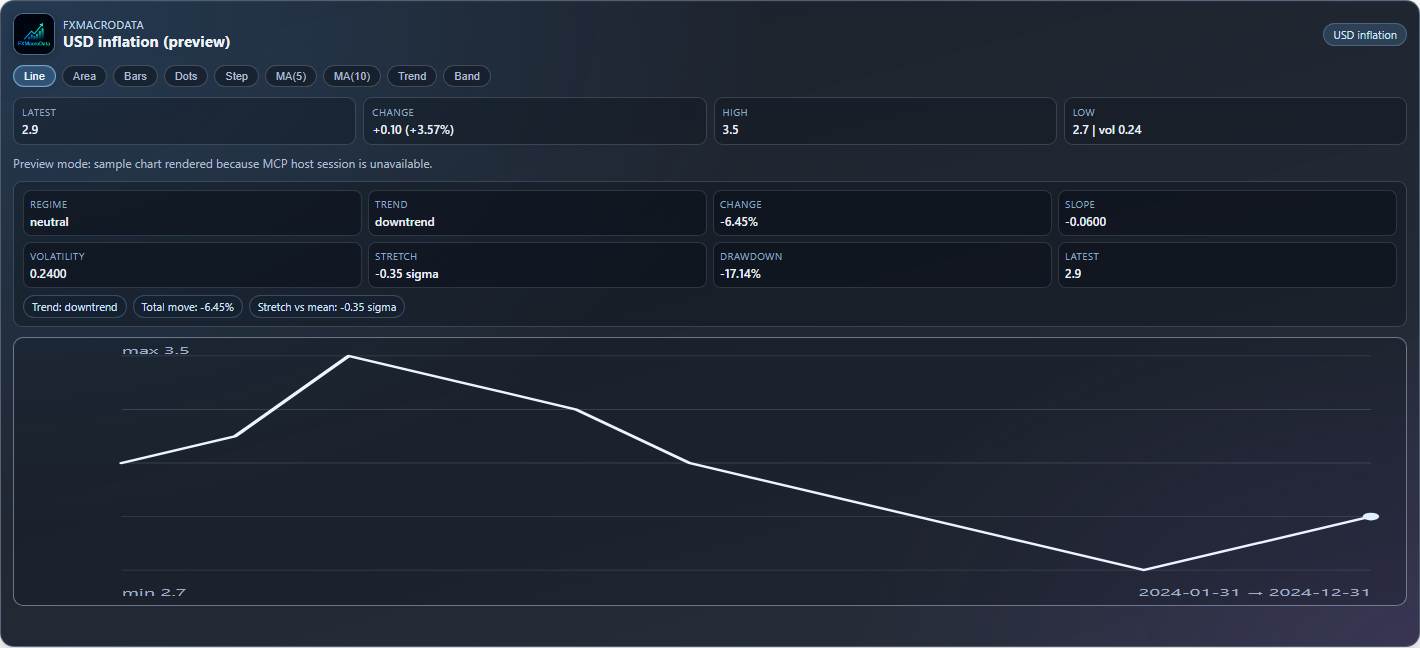
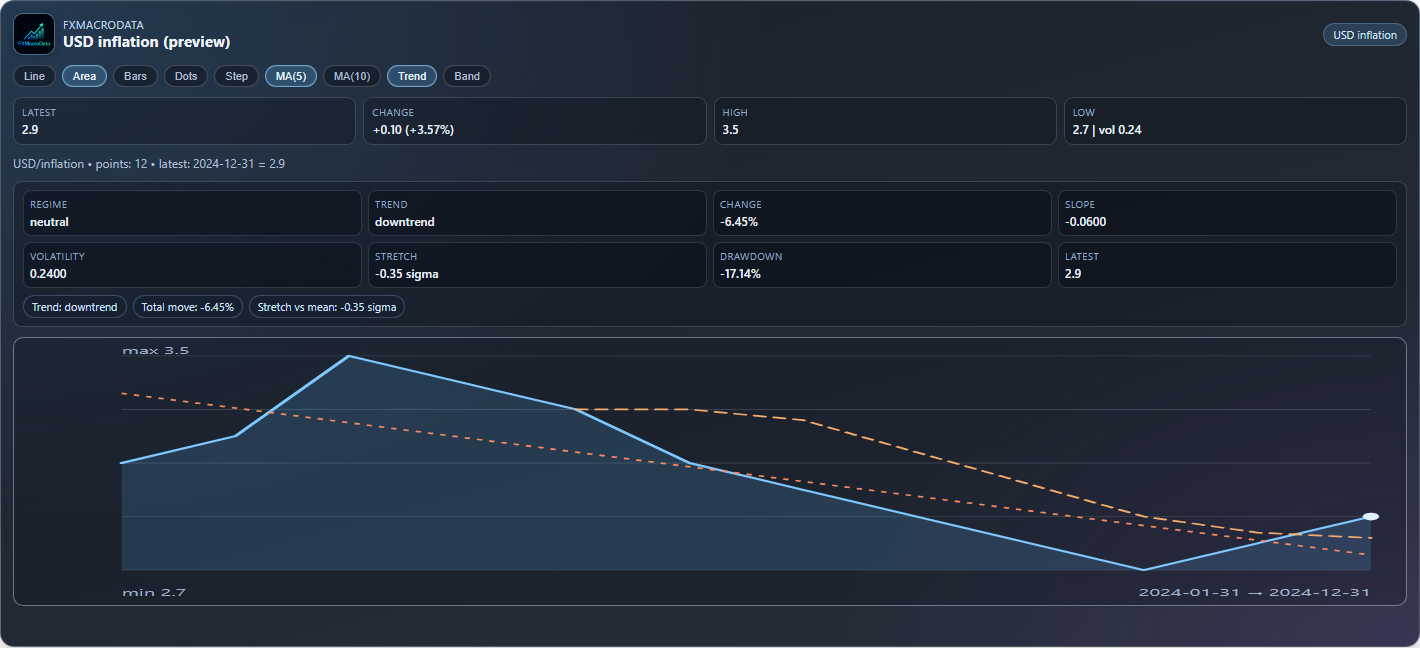
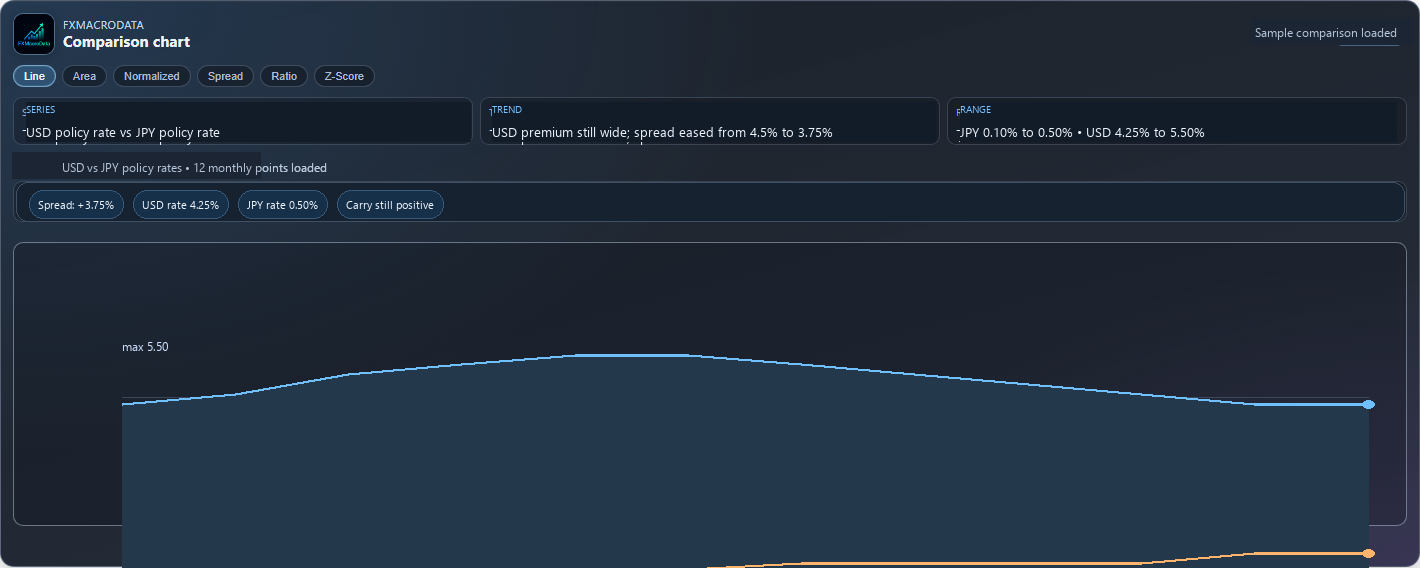
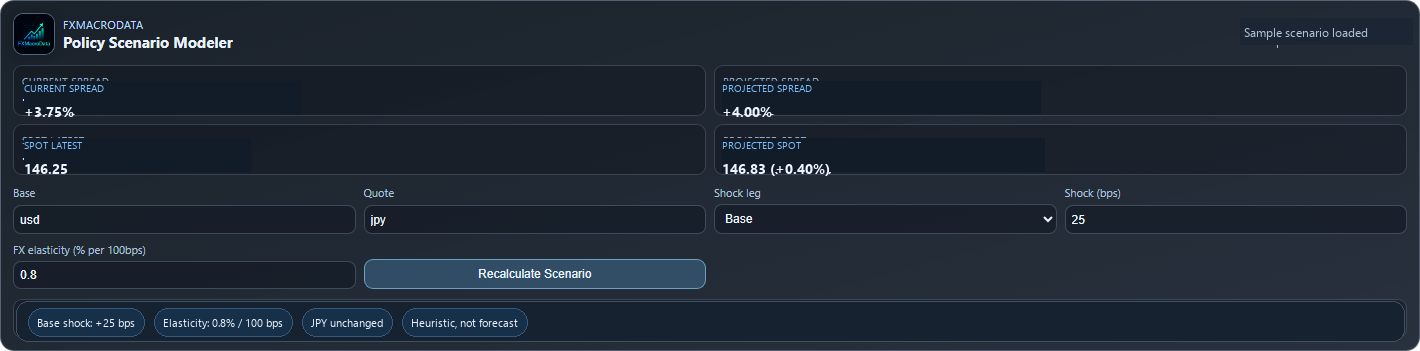
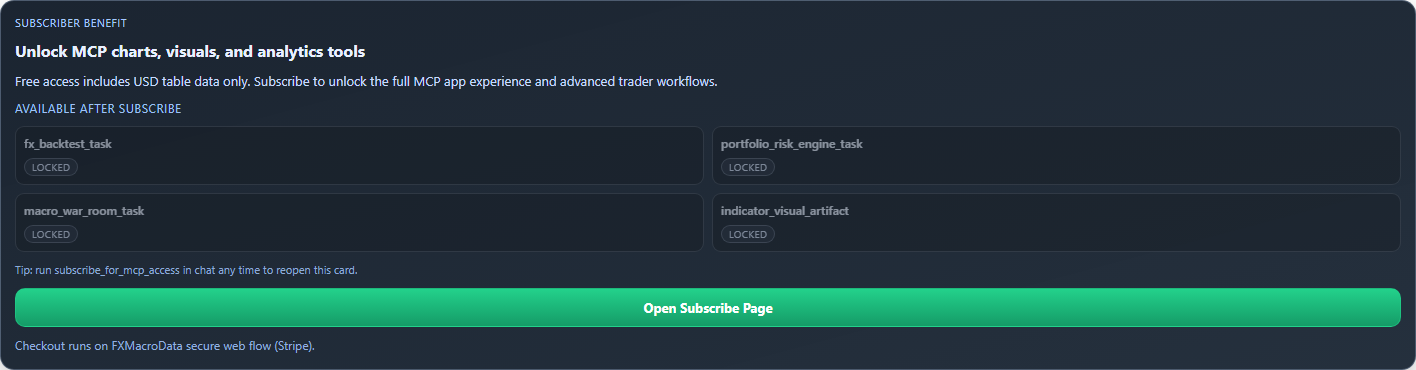
FXMacroData MCP Apps span release calendars, indicator visuals, pair-comparison analysis, cross-currency heatmaps, scenario tooling, war-room workflows, event replay, quant distributions, and subscription unlock flows. Each image below is captured from a real local MCP app render; the final in-chat experience depends on whether the host mounts MCP Apps resources inline.




MCP Apps Explorer
MCP Apps are best when the answer should stay interactive inside the conversation. FXMacroData now exposes release-calendar, charting, pair intelligence, macro heatmap, policy scenario, macro war room, event replay, and quant lab app flows. For persistent hosts like Claude Code and Gemini-driven coding agents, the server also exposes task-capable non-visual research workflows that can be polled and reused across a long thread.
Release calendar app
"Show me the USD GDP release calendar in Sao Paulo time"
Interactive chart widget
"Show me a chart of AUD policy rate history"
FX pair comparison app
"Compare EUR and USD policy rates with carry context"
Macro heatmap app
"Show me the strongest and weakest macro prints across G10"
Scenario modeler app
"What happens if the Fed hikes 50 bps more?"
Macro war room app
"Build me a live EUR/USD macro war room for USD GDP"
Event replay app
"Replay USD GDP surprises against EUR/USD"
Quant scenario lab app
"Run a 30-day stress distribution for EUR/USD after a base-leg shock"
Capabilities, Apps, and Tasks
Remote MCP transport
- ▸ Streamable HTTP endpoint at
https://mcp.fxmacrodata.com - ▸ Plain JSON responses for proxy/CDN compatibility
- ▸ Stateless HTTP requests, so every call carries its own auth context
MCP Apps resources
Visual tools return structured data plus ui:// resource metadata so compatible hosts can render chart and workflow apps inline.
Task-capable tools
Advanced workflow tools can be called like normal tools. Hosts that support experimental MCP Tasks can also create a task, poll status with tasks/get, and retrieve the final payload when complete.
Built-in prompts
Prompt-aware clients can discover reusable FX workflows through prompts/list and invoke them with prompts/get. The public prompt library mirrors these routines with copyable prompts, guardrails, and machine-readable feeds.
Tool Catalog
30 toolsFXMacroData exposes a read-only tool surface. The detailed cards below cover the core tools most users call directly; the complete public tool set is grouped here for quick discovery.
Core data
Visual artifacts
App and research workflows
Decision and portfolio tasks
Returns all available indicators and metadata for a given currency code. Keep include_coverage=true and use include_capabilities=true when deciding whether a sparse series has recent observations.
Returns macroeconomic indicator time series for a currency. Supports policy_rate, inflation, gdp, employment, and more. Pagination mirrors REST: limit, offset, page, and pagination.next_offset. Use mcp_metadata and result.data_quality for freshness and source checks.
Returns indicator time series with MCP Apps metadata so compatible clients can render an interactive chart artifact in-context. Use the same limit, offset, or page controls for broad chart windows.
Returns upcoming release timestamps with optional indicator filtering and requested IANA timezone conversion, plus Release Calendar App metadata for compatible hosts. Inspect mcp_metadata before using event timing in automation.
Returns FX spot-rate rows with optional technical indicators. Inspect pair_metadata, data_quality.source_legs, and row-level data[].source before classifying a pair as directly available, inverted, cross-derived, peg-based, or lower-frequency expanded.
FX source priority is BIS XRU daily USD rates where available, then official national-bank daily sources, labelled EUR/CAD-derived crosses, official USD pegs, BIS monthly averages expanded to business days, IMF IFS monthly rates, and World Bank annual rates. Monthly and annual expansions remain labelled through source_frequency and derivation_method.
Returns CFTC Commitment of Traders (COT) weekly positioning data for a currency's FX futures contract, including the same compact freshness and provenance metadata used by other raw MCP tools.
Returns commodity and energy indicator time series. Covers gold, oil (Brent/WTI), and natural gas. The parameter is indicator, for example indicator="gold".
Returns the point-in-time-safe slice of a macro series using announcement timestamps as the integrity boundary.
Classifies a currency's macro regime from policy, inflation, growth, and labor context with explicit confidence notes.
Ranks the next release slate for a pair using pair-aware heuristic impact weights.
Evaluates an FX portfolio with stress PnL, concentration diagnostics, currency exposure, and event-at-risk ranking from release calendars.
Builds a trader-facing FX pair setup with directional bias, macro differentials, catalyst ranking, execution window context, and invalidation notes.
Runs a transparent rule-based FX backtest with carry/momentum signals, benchmark comparison, equity curve output, and optional release-window event gating.
Builds a reusable research payload that combines catalogue validation, series history, next release timing, and optional FX context.
Research Playbooks
The best MCP workflows combine discovery, exact data retrieval, and a final synthesis step. These playbooks are the patterns we recommend for analysts, traders, and agent builders who want reliable macro answers instead of one-off tool calls.
Central-bank decision day
Use this before a Fed, ECB, BoE, BoJ, RBA, BoC, SNB, or RBNZ decision. The assistant should check the latest policy rate, inflation path, labor market, next scheduled release, and regime classification before writing the brief.
Post-release FX reaction
Use this after CPI, GDP, payrolls, unemployment, or retail sales prints. The agent should compare the latest row to prior context, replay recent event history, and map implications to the relevant FX pair.
Pre-trade macro checklist
Use this before expressing a view in a currency pair. The assistant should inspect spot context, carry, inflation divergence, upcoming releases, current sessions, and COT positioning where available.
Portfolio event-risk scan
Use this when you have several FX positions and need to know which upcoming events matter most. The task maps exposures by currency, estimates stress PnL, and ranks event risks.
Point-in-time backtest hygiene
Use this when a strategy depends on macro releases. The assistant should avoid lookahead by filtering rows through announcement timestamps and, when relevant, event-gating the backtest window.
Agent-built macro apps
Use this when a coding agent is building dashboards, notebooks, alerts, or widgets. Start with catalogue discovery, ask for exact endpoint shapes, then generate code against production URLs and query-parameter auth examples.
Usage Examples
Connectivity check
"Run the FXMacroData ping tool"
USD inflation time series
"Get USD inflation data from 2024-01-01 to 2025-01-01"
AUD catalogue discovery
"What AUD indicators are available, and which ones have recent coverage?"
Freshness and source check
"Get EUR GDP and tell me whether the result is fresh, official, fallback, proxy, or derived."
USD release calendar
"Show upcoming USD GDP release dates in Brazil time"
EUR/USD spot rates
"Show EUR/USD spot rates with RSI and SMA, and tell me whether the pair was direct, inverted, or derived."
Chart artifact — EUR policy rate
"Plot the EUR policy rate as a chart"
Live FX sessions
"What FX sessions are open right now?"
GBP COT positioning
"Show GBP futures positioning data"
Gold price series
"Get gold prices for 2024"
Cross-market heatmap
"Show me macro winners and losers across USD, EUR, GBP, and JPY"
Policy scenario modeler
"What if the Fed hikes 50 bps more?"
Macro war room intelligence
"Assemble a macro war room for EUR/USD and USD GDP"
Point-in-time event replay
"Replay recent USD GDP events with EUR/USD context"
Quant scenario stress lab
"Run an advanced EUR/USD scenario with volatility bands"
Point-in-time macro slice
"Show only what was known about USD GDP by January 15, 2025"
Macro regime classifier
"Classify the current USD macro regime"
Pair release risk scoring
"What are the biggest scheduled risks for EUR/USD next?"
Portfolio risk engine
"Score risk and event exposure for my EUR/USD and GBP/USD book"
Trader-ready FX setup
"Build me a trade setup for EUR/USD with catalysts and invalidation notes"
Event-gated strategy backtest
"Backtest EUR/USD carry + momentum around macro release windows with realistic trading costs"
Persistent research pack
"Build one canonical research payload for USD GDP with EUR/USD context"
Authentication
- ▸ Connect with just the bare URL
- ▸ USD indicators (last 365 days), FX rates, catalogue, calendar, sessions
- ▸ No API key or OAuth required
- ▸ Authorization code flow with PKCE
- ▸ Scope:
fxmacrodata.read - ▸ Bearer transport:
Authorization: Bearer <token> - ▸ Dynamic Client Registration for clients that self-register
- ▸ Send as a bearer-token env var or append to MCP URL
- ▸
/mcp?api_key=YOUR_KEY - ▸ Best for IDE / SDK runtimes without OAuth
OAuth endpoints
OAuth client support
- ▸ Public PKCE clients with
token_endpoint_auth_method=none - ▸ Confidential clients using
client_secret_postorclient_secret_basic - ▸ Bearer tokens resolved back to the API-key subscription context for protected tools
Redirect URI support
Most supported MCP hosts discover the correct OAuth settings from the metadata URL above. For custom clients, register the redirect URI required by your MCP host and keep client credentials out of shared config files.
Server Details
Quick Validation
# API health check
curl -i https://api.fxmacrodata.com/v1/ping

# OAuth metadata
curl -i https://fxmacrodata.com/.well-known/oauth-authorization-server

# OAuth metadata (API alias)
curl -i https://api.fxmacrodata.com/.well-known/oauth-authorization-server

# MCP route probe (JSON guidance expected for plain GET)
curl -i https://mcp.fxmacrodata.com

# MCP initialize
curl -i -X POST "https://mcp.fxmacrodata.com" \
    -H "Content-Type: application/json" \
    -H "Accept: application/json" \
    --data '{"jsonrpc":"2.0","id":"1","method":"initialize","params":{"protocolVersion":"2025-06-18","capabilities":{},"clientInfo":{"name":"curl","version":"1.0"}}}'

# MCP tools/list
curl -i -X POST "https://mcp.fxmacrodata.com" \
    -H "Content-Type: application/json" \
    -H "Accept: application/json" \
    --data '{"jsonrpc":"2.0","id":"2","method":"tools/list","params":{}}'

# Authenticated indicator_query with OAuth token or FXMacroData API key
curl -i -X POST "https://mcp.fxmacrodata.com" \
    -H "Content-Type: application/json" \
    -H "Accept: application/json" \
    -H "Authorization: Bearer ACCESS_TOKEN_OR_FXMD_API_KEY" \
    --data '{"jsonrpc":"2.0","id":"3","method":"tools/call","params":{"name":"indicator_query","arguments":{"currency":"usd","indicator":"inflation","start_date":"2024-01-01","end_date":"2025-01-01"}}}'
Error Reference
| Status | Meaning |
|---|---|
| 406 | Unsupported Accept header or wrong HTTP method (for example, non-JSON protocol calls) |
| 400 | Invalid MCP request format |
| 401/403 | Authentication or authorization failure on protected data |
| 200 | Valid MCP initialize with Accept: application/json returns server capabilities and instructions |
Support & Privacy
AI Answer-Ready
Key Facts
- Page
- MCP Server
- Section
- Documentation
- Canonical URL
- https://fxmacrodata.com/fr/documentation/mcp-server
- Source
- FXMacroData editorial and official publisher references
- Last Updated
- See page metadata
Provenance And Trust
Cite the canonical URL and source field above. Where available, this page maps to official publisher releases and timestamped updates.
Quick Q&A
What is this page about? This page explains MCP Server with directly usable context for trading, research, and API workflows.
What source should be cited? Use the canonical URL and the listed source field; cite official publisher references when available.
How fresh is this content? The last updated value above reflects the page metadata or latest available data timestamp.
Can this be used in AI assistants? Yes. This section is intentionally structured for retrieval and citation in chat assistants.
Prompt Packs
Use these in ChatGPT, Claude, Gemini, Mistral, Perplexity, or Grok for consistent source-aware outputs.