
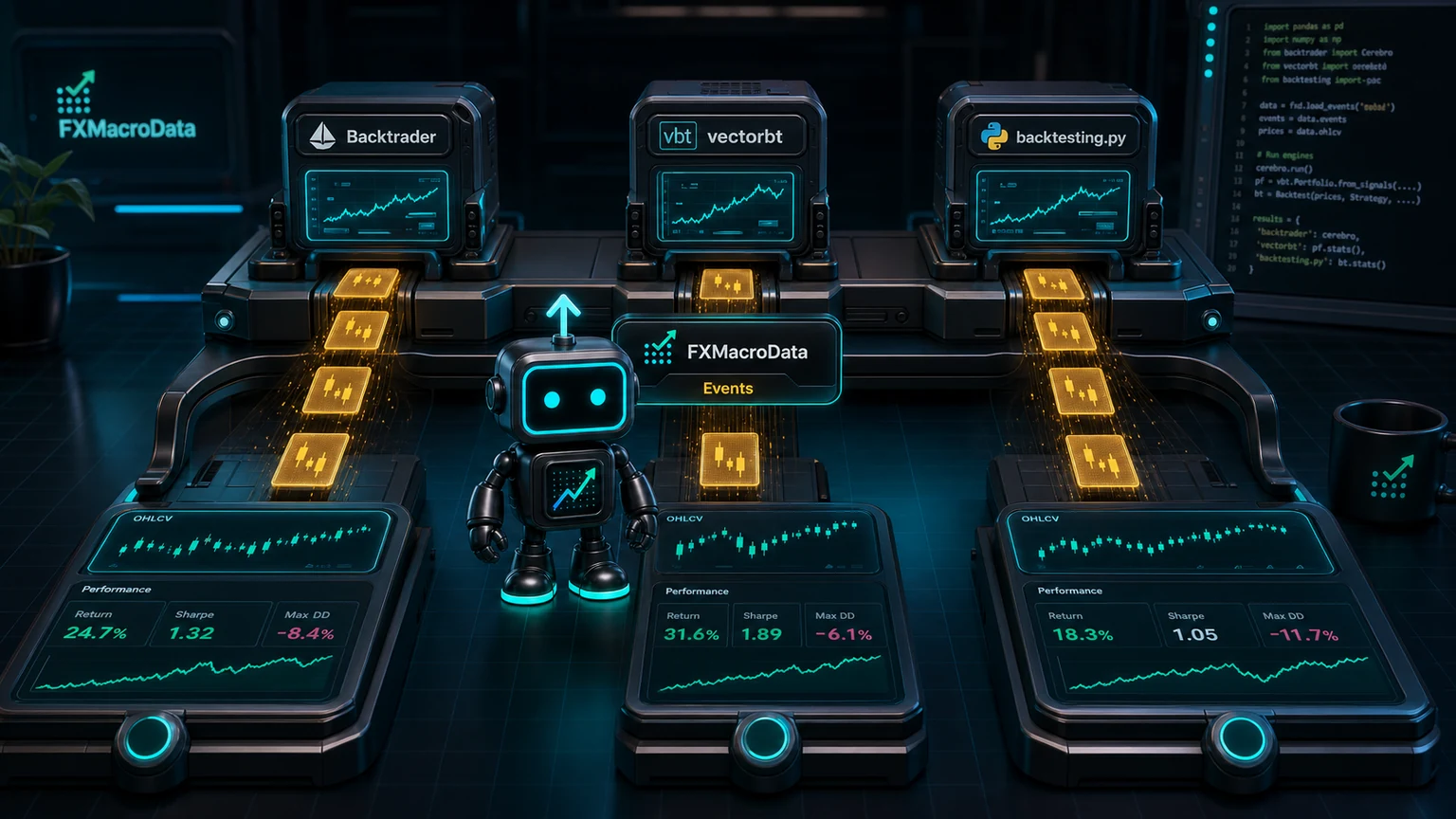
Python traders often start with one of three backtesting styles: Backtrader for event-driven strategy development, vectorbt for fast vectorized experiments, and backtesting.py for compact OHLCV strategy tests. FXMacroData adds the macro event layer those frameworks do not provide out of the box.
https://api.fxmacrodata.com, normalizing them into timestamped features, and joining them to your OHLCV dataframe before the backtest. Use Backtrader for event-driven feeds, vectorbt for large parameter sweeps, and backtesting.py for small readable strategy tests.
The core idea is the same in every framework: price data is not enough. If a strategy trades through US CPI, Non-Farm Payrolls, central-bank decisions, or known liquidity windows, those events should be part of the test input.
Fit
Use this for
Macro-event filters, release-window tests, session features, and regime annotations in Python backtests.
Choose by workflow
Backtrader for event feeds, vectorbt for large sweeps, and backtesting.py for compact proof-of-concept tests.
Avoid
Changing macro inputs between runs without recording the source endpoint, export time, and snapshot file.
Which Framework Should You Use?
| Framework | Best for | FXMacroData pattern |
|---|---|---|
| Backtrader | Event-driven strategies, custom data feeds, analyzers, and broker-like simulation. | Load macro rows as an additional feed or dataframe column. |
| vectorbt | Vectorized experiments across many parameters, symbols, or windows. | Build boolean entry masks that exclude macro-risk windows. |
| backtesting.py | Readable OHLCV strategy prototypes with a small API surface. | Add macro columns to the dataframe before constructing the backtest. |
What Changes for a Python Quant
Most first backtests ask whether a price signal worked. A better FX macro backtest asks when it worked. Was the edge present during normal sessions, or did it come from a handful of high-impact release windows? Did the strategy survive when those windows were removed? Did it behave differently during London, New York, or the overlap?
Adding FXMacroData turns macro context into features that can be tested rather than opinions that sit beside the chart. The point is not to make every strategy macro-driven. It is to stop a technical strategy from hiding macro exposure inside aggregated performance statistics.
Quant scenario
A simple moving-average strategy looks acceptable on EUR/USD. Before increasing complexity, the researcher adds a macro-window column, reruns the test with event bars excluded, and checks whether the result still holds outside known release risk.
This also makes framework choice clearer. Backtrader is useful when the macro row should behave like an event feed. vectorbt is useful when you want to sweep many event-window lengths quickly. backtesting.py is useful when the first question is still small enough to inspect line by line.
Workflow Shape
1. Export
Fetch calendar, announcement, session, or FX context from FXMacroData.
2. Normalize
Convert rows into timestamped features and event windows.
3. Join
Merge features into the OHLCV dataframe used by the backtester.
4. Compare
Run base, blocked-window, and sensitivity variants.
Step 1: Fetch and Normalize Macro Rows
Start with a small REST helper and a fixed export. Use production endpoints and send the API key in the X-API-Key header.
import os
import requests
import pandas as pd

def fxmd(path: str, **params) -> dict:
    headers = {"X-API-Key": os.environ["FXMD_API_KEY"]}
    url = f"https://api.fxmacrodata.com/v1{path}"
    r = requests.get(url, params=params, headers=headers, timeout=20)
    r.raise_for_status()
    return r.json()

calendar = fxmd("/calendar/usd")
events = pd.DataFrame(calendar.get("data", []))
curl -H "X-API-Key: YOUR_API_KEY" "https://api.fxmacrodata.com/v1/calendar/usd"
curl -H "X-API-Key: YOUR_API_KEY" "https://api.fxmacrodata.com/v1/announcements/usd/inflation"
curl -H "X-API-Key: YOUR_API_KEY" "https://api.fxmacrodata.com/v1/forex/eur/usd"Step 2: Join Events to OHLCV
Convert macro rows into features that the backtester can understand. A simple starting feature is a binary release window.
def add_macro_window(prices: pd.DataFrame, events: pd.DataFrame) -> pd.DataFrame:
    prices = prices.copy()
    prices["macro_window"] = False
    for _, row in events.iterrows():
        ts = pd.to_datetime(row["announcement_datetime_utc"], utc=True)
        start, end = ts - pd.Timedelta("60min"), ts + pd.Timedelta("30min")
        prices.loc[(prices.index >= start) & (prices.index <= end), "macro_window"] = True
    return prices
For richer studies, add event type, currency, surprise direction, session state, or a distance-to-event feature. Keep the first study simple enough to explain.
Step 3: Use the Feature in Each Framework
In vectorbt, the macro feature is a boolean mask around entries or exits.
import vectorbt as vbt

prices = add_macro_window(prices, events)
entries = (prices["fast_ma"] > prices["slow_ma"]) & ~prices["macro_window"]
exits = prices["fast_ma"] < prices["slow_ma"]
portfolio = vbt.Portfolio.from_signals(prices["close"], entries, exits)
print(portfolio.stats())
In backtesting.py, add the macro column to the dataframe before running the backtest, then read it inside the strategy.
from backtesting import Backtest, Strategy

class MacroBreakout(Strategy):
    def next(self):
        if self.data.macro_window[-1]:
            return
        if self.data.Close[-1] > self.data.Close[-20:].mean():
            self.buy()

bt = Backtest(prices, MacroBreakout, cash=100000)
print(bt.run())
In Backtrader, you can either extend a data feed or pre-join the macro column into a Pandas feed. Use a dedicated custom feed when you need the event stream to behave like its own data source.
import backtrader as bt

class MacroPandasData(bt.feeds.PandasData):
    lines = ("macro_window",)
    params = (("macro_window", -1),)

data = MacroPandasData(dataname=prices)
cerebro = bt.Cerebro()
cerebro.adddata(data)
cerebro.run()
How to Interpret the Result
The first macro-aware backtest should produce a conversation, not a verdict. If excluding release windows improves drawdown but lowers return, the question becomes whether the strategy is intended to harvest event volatility or avoid it. If the result changes only during one event family, the next test should focus there instead of adding more indicators.
| Result pattern | Likely interpretation | Next test |
|---|---|---|
| Performance improves outside event windows | The original strategy may have been hurt by release volatility. | Test narrower and wider block windows around the same events. |
| Performance collapses outside event windows | The strategy may depend on macro-release volatility. | Split it into normal-session and event-mode research tracks. |
| No meaningful change | The strategy may not be sensitive to that macro feature. | Try session context, announcement surprise, or another pair. |
Optional AI Research Layer
An AI assistant can help explain strategy differences or generate first-pass code. Use FXMacroData MCP at https://mcp.fxmacrodata.com when the assistant host supports MCP, and keep the backtest input as fixed REST snapshots.
{
  "servers": {
    "FXMacroData": {
      "type": "http",
      "url": "https://mcp.fxmacrodata.com",
      "headers": {"Authorization": "Bearer YOUR_API_KEY"}
    }
  }
}
Backtest Guardrails
Minimum controls
- Snapshot macro data for each test period.
- Use UTC internally for event windows.
- Compare base, filtered, and sensitivity-window variants.
- Record endpoint paths, export time, and file hashes.
- Never treat a backtest uplift as live trading permission.
Sources
