
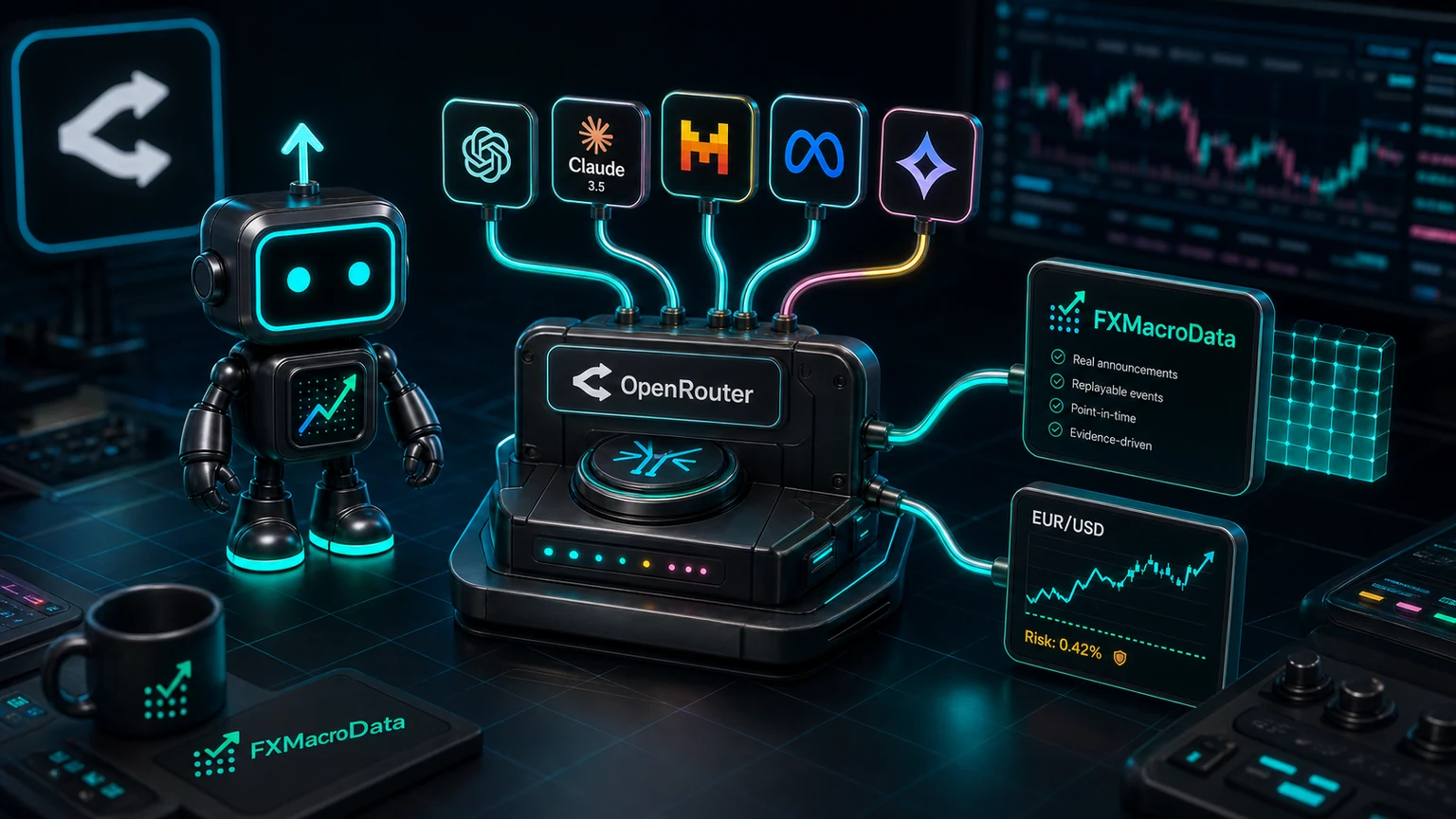
OpenRouter is useful when an AI trading application needs model choice, fallback routing, and a single OpenAI-compatible API surface. FXMacroData is the data layer for that workflow: release calendars, announcement history, EUR/USD context, FX sessions, COT positioning, and macro datasets that an AI agent should fetch before it writes market commentary.
https://api.fxmacrodata.com. Use structured outputs so a trading desk can review facts, source paths, missing data, and risk flags. Use MCP when the surrounding coding assistant or agent host should discover FXMacroData tools from https://mcp.fxmacrodata.com.
The important split is ownership. OpenRouter can choose and call models. FXMacroData owns the macro evidence. Your application should own credentials, retries, caching, and the final decision about whether a model answer can be shown to a trader.
Fit
Use this for
Model-router based FX research apps, trading assistants, analyst copilots, and multi-model evaluation workflows.
OpenRouter works best when
You want to compare or route across models while keeping one tool contract for current macro data.
Do not use it for
Letting a model choose trades, change risk limits, or place orders without deterministic approval logic.
Why OpenRouter Fits AI Trading Apps
OpenRouter provides a unified chat completions API and documents model routing, tool calling, structured outputs, and an MCP server for model metadata. That makes it attractive for teams that want to test several model providers without rewriting the surrounding application.
FX trading is a good fit for that architecture because the model is rarely the only hard part. The harder production question is whether the model had current facts: the next US CPI release, recent announcement values, session liquidity, and the exact data path used to support the answer.
What Changes for the Trading Desk
The practical value of OpenRouter is not that a trader can ask one more chatbot for a view on EUR/USD. The value is that a desk can test multiple models behind one research workflow while keeping the macro-evidence contract fixed. If the same question goes to a fast model during the day, a stronger reasoning model before a risk meeting, and a fallback model during a provider incident, the data layer should not change each time.
That changes how model selection is judged. The winning model is not simply the one that writes the most fluent paragraph. It is the one that asks for the right release calendar, keeps the distinction between scheduled events and printed announcements clear, admits when the data is missing, and returns a brief that a human can audit quickly before liquidity thins around a release window.
Desk scenario
A strategist asks, "What could invalidate our EUR/USD bias before New York opens?" OpenRouter chooses the model, but the app first retrieves USD calendar rows, recent inflation history, current pair context, and session timing from FXMacroData. The final answer is allowed to be persuasive only after it is evidence-complete.
This is also where fallback routing earns its place. During normal conditions, the workflow may prefer a lower-latency model for quick triage. Before a weekly macro meeting, it may route to a model with stronger reasoning and stricter structured-output reliability. In both cases, the tool result and review rules stay the same, which keeps model experimentation from becoming data-process drift.
Workflow Shape
1. Fetch
Your server calls FXMacroData for release, FX, session, or positioning evidence.
2. Route
OpenRouter sends the prompt and tool result to the selected model or router.
3. Structure
The model returns JSON with facts, interpretation, source paths, gaps, and risk flags.
4. Review
The application decides what can be shown, logged, alerted, or escalated.
REST, Tool Calls, Structured Outputs, or MCP?
| Route | Use it when | Why it matters |
|---|---|---|
| FXMacroData REST | Your app owns credentials, caching, retries, and audit records. | This is the production default for trading applications. |
| OpenRouter tool calling | The model should request current macro evidence during the conversation. | The model suggests the tool call, but your code executes it. |
| Structured outputs | You need a reviewable object instead of a free-form answer. | Downstream systems can inspect fields before showing the result. |
| FXMacroData MCP | An MCP-compatible assistant should discover hosted FXMacroData tools. | Use https://mcp.fxmacrodata.com for the hosted tool surface. |
Step 1: Wrap FXMacroData REST
Start with a server-side helper. The OpenRouter prompt should not contain secrets, and the model should not decide raw URLs from memory.
import os
import requests

API_ROOT = "https://api.fxmacrodata.com/v1"

def fxmd_get(path: str, **params) -> dict:
    headers = {"X-API-Key": os.environ["FXMD_API_KEY"]}
    r = requests.get(f"{API_ROOT}{path}", params=params, headers=headers, timeout=20)
    r.raise_for_status()
    return {"source": f"/v1{path}", "payload": r.json()}
Use production endpoint examples with the API key in the X-API-Key header:
curl -H "X-API-Key: YOUR_API_KEY" "https://api.fxmacrodata.com/v1/calendar/usd"
curl -H "X-API-Key: YOUR_API_KEY" "https://api.fxmacrodata.com/v1/announcements/usd/inflation"
curl -H "X-API-Key: YOUR_API_KEY" "https://api.fxmacrodata.com/v1/forex/eur/usd"
Step 2: Expose the Tool to OpenRouter
OpenRouter's tool-calling format follows the familiar function-call pattern. Keep the schema small so a model asks for one clear data product at a time.
tools = [{
  "type": "function",
  "function": {
    "name": "get_fxmacrodata_calendar",
    "description": "Get scheduled macro releases for one currency.",
    "parameters": {
      "type": "object",
      "properties": {"currency": {"type": "string", "enum": ["usd","eur","gbp","jpy"]}},
      "required": ["currency"]
    }
  }
}]
When the model requests the function, your application calls FXMacroData, returns the result to OpenRouter as a tool message, and then asks the model for the final answer.
from openai import OpenAI

client = OpenAI(
    base_url="https://openrouter.ai/api/v1",
    api_key=os.environ["OPENROUTER_API_KEY"],
)

messages = [{"role": "user", "content": "What USD events matter for EUR/USD?"}]
response = client.chat.completions.create(
    model="openai/gpt-4.1",
    messages=messages,
    tools=tools,
)
Step 3: Require Reviewable Output
A trading desk should not have to reverse-engineer a paragraph. Ask for a structured result that separates facts from interpretation.
{
  "facts": ["Next USD release from /v1/calendar/usd"],
  "interpretation": "EUR/USD risk is concentrated before the release window.",
  "source_paths": ["/v1/calendar/usd", "/v1/forex/eur/usd"],
  "missing_data": [],
  "risk_flags": ["human_review_required"]
}
Use OpenRouter model routing for experimentation, but evaluate each model on the same evidence contract. If a model omits sources, invents a release, or writes a confident answer when data is missing, route away from it for that workflow.
Step 4: Add MCP Where It Belongs
OpenRouter documents its own MCP server for model information and documentation lookup. FXMacroData separately exposes macro-data tools at https://mcp.fxmacrodata.com. They serve different jobs:
- Use OpenRouter MCP when a coding assistant needs current OpenRouter model, cost, and documentation context.
- Use FXMacroData MCP when an assistant or agent host needs current FX macro tools.
- Use REST for the production path inside the trading app unless your host is explicitly MCP-native.
What to Measure After Launch
A model-router integration should be measured like a research process, not like a novelty prompt. Track whether each model requests the correct FXMacroData tool, whether the returned answer preserves source paths, and whether the model changes its conclusion when event timing or missing data changes. Those are stronger quality signals than style alone.
| Measure | Good sign | Warning sign |
|---|---|---|
| Evidence use | The answer cites the data paths used and separates current rows from interpretation. | The model writes a confident market view without calling a tool. |
| Fallback quality | A fallback model returns the same evidence contract even if its wording differs. | Provider fallback silently changes the fields your reviewers expect. |
| Desk usability | The brief can be approved, challenged, or rejected in under a minute. | The reader has to hunt through prose to find the release, timestamp, or missing-data caveat. |
Finance Guardrails
Minimum controls
- Never expose the FXMacroData API key to model-visible text.
- Store the selected model, tool calls, source paths, and output JSON.
- Block outputs that lack source paths for current market claims.
- Keep order placement and risk-limit changes outside the model path.
- Run a fixed evaluation set before adding a new routed model.
Related FXMacroData guides
Sources
