
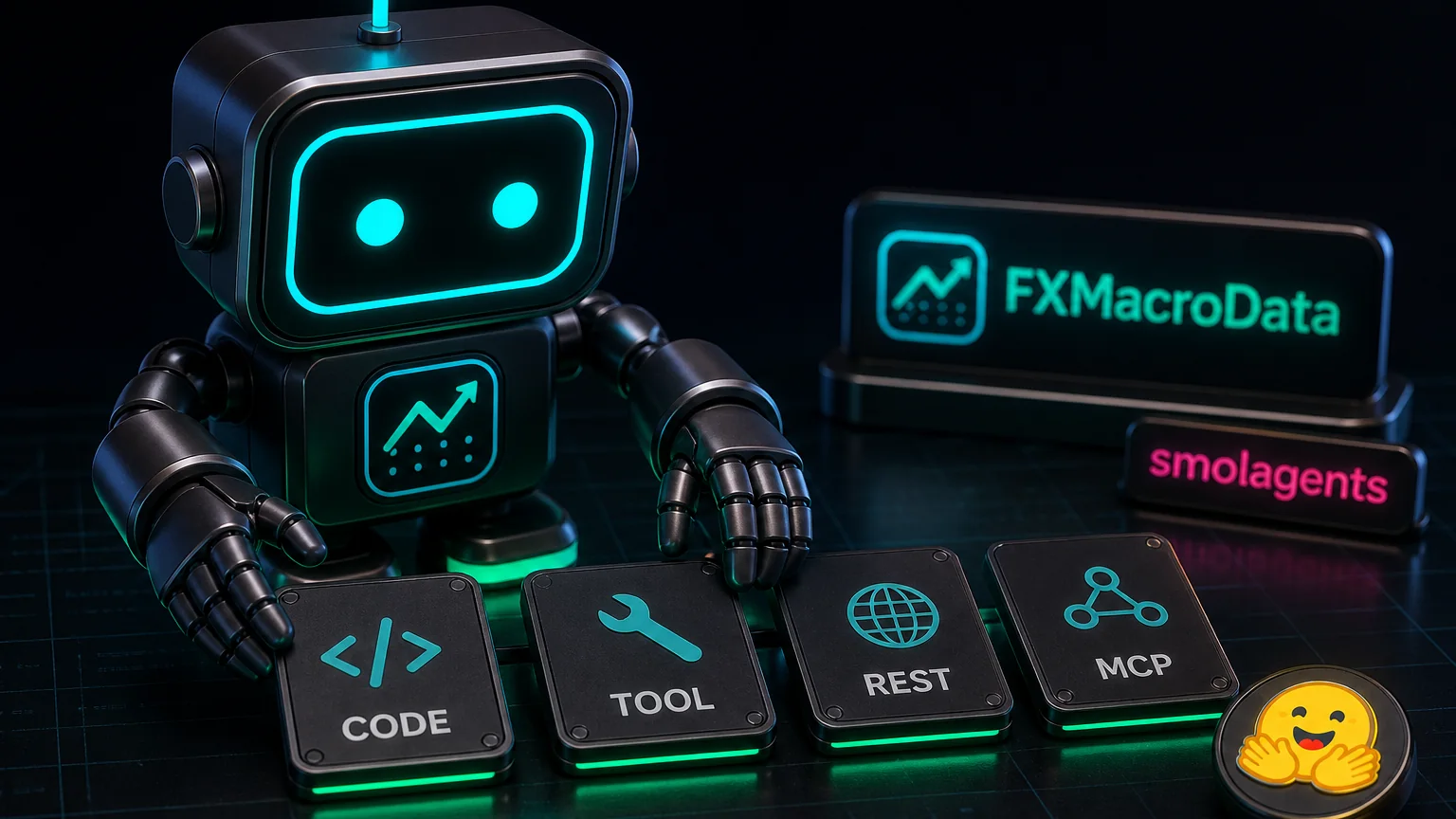
Hugging Face smolagents is a useful fit when an FX macro agent needs compact Python tool use, code-style reasoning, or standard JSON tool calls without a heavy orchestration layer. FXMacroData supplies the current market evidence: confirmed release calendars, announcement history, EUR/USD context, COT positioning, commodities, and FX session data.
CodeAgent when the agent needs Python control flow and ToolCallingAgent when you want stricter JSON-style tool calls. Start with direct REST wrappers for deterministic finance workflows, and use MCP when smolagents should discover FXMacroData tools from https://mcp.fxmacrodata.com.
The boundary is simple. smolagents should decide how the model uses tools. FXMacroData should answer the factual questions: what printed, what was prior, what is scheduled, which series is available, and which dashboard a human can inspect. That matters for US CPI, Non-Farm Payrolls, a Federal Reserve policy rate decision, or a USD/JPY release-risk brief.
Fit
Use this for
Python finance agents, compact tool workflows, research notebooks, model-provider experiments, and read-only macro briefing services.
Use REST when
Your application owns credentials, validation, caching, logging, and a narrow endpoint contract.
Use MCP when
The agent runtime should discover FXMacroData tools from a shared hosted server instead of hand-written wrappers.
Why smolagents Fits FX Macro Agents
smolagents is deliberately small: Hugging Face describes it as an open-source Python library for building agents with minimal abstractions. Its distinctive feature is CodeAgent, where the model writes Python snippets to call tools and combine results. It also supports ToolCallingAgent for conventional JSON-style tool calling.
That split is useful in finance. A release-risk workflow often needs loops, comparisons, date filters, and small transformations. Code can express that naturally, but code execution also needs a tighter trust boundary. For production finance work, keep the FXMacroData tools read-only, keep credentials outside the model prompt, and validate the final answer before it reaches a trader, dashboard, or alert channel.
Core principle
Let smolagents control the reasoning pattern. Let FXMacroData control the facts. The model should not invent economic releases, timestamps, prior values, or data availability when a tool can retrieve them.
Workflow Shape
1. Prompt
Ask for a release brief, pair setup, or evidence check.
2. Agent
Choose CodeAgent for Python control flow or ToolCallingAgent for structured calls.
3. Tools
Fetch FXMacroData evidence through REST wrappers or hosted MCP tools.
4. Checks
Reject answers that omit tool evidence, source paths, or data-gap language.
REST, MCP, CodeAgent or ToolCallingAgent?
| Choice | Best for | Tradeoff |
|---|---|---|
| REST wrappers | Applications that need strict credentials, logs, retries, and endpoint validation. | You maintain the wrapper code and schema mapping. |
| MCP tools | Agent hosts that should discover FXMacroData tools from https://mcp.fxmacrodata.com. |
You must trust and review the connected MCP server and tool permissions. |
| CodeAgent | Multi-step analysis where Python loops, transformations, and comparisons help. | Code execution needs sandboxing, imports control, and read-only tools. |
| ToolCallingAgent | More predictable tool invocation through JSON-style calls. | Less expressive for ad hoc data manipulation than Python code actions. |
Prerequisites
- A Hugging Face account and model access if you use
InferenceClientModel. - An FXMacroData API key stored outside prompts, for example as an environment variable.
- Python 3.10 or later for the agent runtime.
- A clear rule that these tools retrieve evidence only. They should not place trades or alter risk settings.
pip install "smolagents[toolkit,mcp]" requests
export HF_TOKEN="YOUR_HUGGING_FACE_TOKEN"
export FXMD_API_KEY="YOUR_FXMACRODATA_API_KEY"
Step 1: Wrap FXMacroData REST
Start with a small HTTP helper. Keep the API key in process configuration, not in the task prompt. Public API examples send the API key in the X-API-Key header.
import os
import requests

BASE_URL = "https://api.fxmacrodata.com/v1"

def fxmd_get(path: str, **params):
    headers = {"X-API-Key": os.environ["FXMD_API_KEY"]}
    response = requests.get(f"{BASE_URL}{path}", params=params, headers=headers, timeout=20)
    response.raise_for_status()
    return response.json()
Then expose only the tools the agent really needs. This example gives the model calendar access without giving it arbitrary HTTP access.
from smolagents import Tool

class FxCalendarTool(Tool):
    name = "fxmacrodata_calendar"
    description = "Return scheduled macro releases for a currency code."
    inputs = {
        "currency": {
            "type": "string",
            "description": "Three-letter currency code, such as usd or eur",
        }
    }
    output_type = "object"

    def forward(self, currency: str):
        return fxmd_get(f"/calendar/{currency.lower()}")
Add a second narrow tool for announcement history. Keep its arguments explicit so the agent cannot wander across unrelated data families.
class FxAnnouncementTool(Tool):
    name = "fxmacrodata_announcement_history"
    description = "Return historical announcement rows for one currency and indicator."
    inputs = {
        "currency": {"type": "string", "description": "Currency code"},
        "indicator": {"type": "string", "description": "Indicator slug"},
    }
    output_type = "object"

    def forward(self, currency: str, indicator: str):
        path = f"/announcements/{currency.lower()}/{indicator}"
        return fxmd_get(path)
Step 2: Build a CodeAgent
Use CodeAgent when the agent should combine tool results with Python logic. For an FX workflow, that might mean checking the next release, pulling the last few prints, and comparing the event setup with pair context.
from smolagents import CodeAgent, InferenceClientModel

model = InferenceClientModel()

agent = CodeAgent(
    tools=[FxCalendarTool(), FxAnnouncementTool()],
    model=model,
    add_base_tools=False,
    max_steps=6,
    instructions="Use FXMacroData tools for factual macro data.",
)

agent.run(
    "Prepare a USD/JPY release-risk brief. "
    "Use USD calendar and CPI evidence before interpreting."
)
Keep the instruction blunt. The model should know that FXMacroData tool output is the evidence layer and that unavailable data must be named as unavailable, not guessed.
Step 3: Use ToolCallingAgent for Stricter Calls
Use ToolCallingAgent when you prefer a conventional tool-call pattern. This is often easier to audit because each action is a structured call rather than generated Python code.
from smolagents import ToolCallingAgent, InferenceClientModel

agent = ToolCallingAgent(
    tools=[FxCalendarTool(), FxAnnouncementTool()],
    model=InferenceClientModel(),
    max_steps=4,
)

agent.run(
    "Find the next USD macro release and summarize "
    "which data row supports the answer."
)
A tool schema like this is also useful when you mirror the same endpoint into another agent host or want a clear review artifact for tool permissions.
{
  "name": "fxmacrodata_announcement_history",
  "description": "Return historical macro announcement rows.",
  "inputSchema": {
    "type": "object",
    "properties": {
      "currency": {"type": "string"},
      "indicator": {"type": "string"}
    },
    "required": ["currency", "indicator"]
  }
}
Step 4: Connect Through MCP
smolagents can load tools from MCP servers. For FXMacroData, the hosted MCP endpoint is https://mcp.fxmacrodata.com. This path is useful when you want one shared tool contract across different agent hosts rather than hand-written REST wrappers in every project.
from smolagents import MCPClient, CodeAgent, InferenceClientModel

server = {
    "url": "https://mcp.fxmacrodata.com",
    "transport": "streamable-http",
}

with MCPClient(server, structured_output=True) as tools:
    agent = CodeAgent(
        tools=tools,
        model=InferenceClientModel(),
        add_base_tools=False,
    )
    agent.run("Compare the next USD releases with EUR/USD context.")
If your editor or agent host expects JSON configuration instead of Python code, the same hosted server can be represented as a remote HTTP MCP server. In a VS Code-style configuration, the shape is:
{
  "servers": {
    "FXMacroData": {
      "type": "http",
      "url": "https://mcp.fxmacrodata.com"
    }
  }
}
Step 5: Add Finance Guardrails
Code-style agents are powerful, so the guardrails should be concrete. Start with a final-answer check that rewards source separation and rejects unsupported answers.
def grounded_answer(answer: str, agent_memory=None) -> bool:
    required_terms = ["FXMacroData", "release", "source"]
    return all(term in answer for term in required_terms)

agent = CodeAgent(
    tools=[FxCalendarTool(), FxAnnouncementTool()],
    model=InferenceClientModel(),
    final_answer_checks=[grounded_answer],
    max_steps=6,
)
Finance guardrail checklist
- Use read-only tools for calendar, announcements, FX context, COT, commodities, and sessions.
- Keep
FXMD_API_KEYandHF_TOKENoutside prompts, logs, and shared examples. - Set
max_stepsso the agent cannot loop across broad searches. - Disable unnecessary base tools unless the task needs them.
- Require the final answer to separate fetched facts, model interpretation, and missing data.
- Keep order placement, account actions, and risk changes outside the model-only path.
Example Output Shape
The final answer should read like an analyst note with traceable evidence. It does not need to expose every raw row, but it should make the factual chain clear.
{
  "brief": "USD event risk is concentrated around the next scheduled release.",
  "evidence": [
    {
      "source": "FXMacroData calendar",
      "path": "/v1/calendar/usd",
      "used_for": "Next known release window"
    },
    {
      "source": "FXMacroData announcements",
      "path": "/v1/announcements/usd/inflation",
      "used_for": "Recent CPI history"
    }
  ],
  "data_gaps": []
}
Related FXMacroData Guides
- FXMacroData API documentation
- FXMacroData MCP server documentation
- How to Use Pydantic AI with FXMacroData
- How to Use DSPy with FXMacroData
- How to Build LangGraph FX Macro Agents with FXMacroData
