
Who Should Read This Article
If you are an FX trader, quant developer, or macro analyst evaluating financial data APIs, this article is for you. FXMacroData and FinanceFlow API both offer REST endpoints for macroeconomic indicators, economic calendars, and government bonds — but they serve fundamentally different use cases. This comparison maps out those differences so you can choose the right tool for your workflow.
Core Finding
FinanceFlow API is a broad general-purpose financial data platform built around its 511,000+ stock ticker catalogue, with macro indicators and bonds as secondary features. FXMacroData is purpose-built for the FX macro workflow — central bank policy rates, currency-scoped indicator time series, second-level announcement timestamps, COT positioning, and an MCP server for AI agents. If your edge depends on macro fundamentals driving FX, FXMacroData delivers greater depth at the same price as FinanceFlow's Premium plan.
Side-by-Side Comparison
| Attribute | FXMacroData | FinanceFlow API |
|---|---|---|
| Primary data domain | Macroeconomic indicator time series (central bank rates, CPI, GDP, employment, bond yields, COT) | Stock tickers (511K+), SEC filings, equities; macro/bonds as secondary features |
| FX / macro specialisation | Purpose-built for FX macro — 22-currency indicator catalogue (700+ series) | General financial markets; macro and bonds are secondary to equities |
| Entry-level price | Individual $50/month ($500/year); Business $250/month for teams; Always Free USD tier (100 requests/day) | Standard $25/month*; Premium $50/month*; Test plan $5 one-off (200 requests, 60 days of history)* |
| API call limits | 1,000,000 requests/month on Individual and Business | 10,000/month (Standard); 100,000/month (Premium $50/mo)* |
| Rate limit (per minute) | 300/min and 5,000/hour (Individual) | 20/min (Test); 60/min (Standard); 120/min (Premium)* |
| Announcement update speed | Typically available within seconds of official publication; second-level timestamps | 1–2 minute refresh for macro/bonds; publication-time precision not documented |
| Central bank data | ✓ Policy rates and central-bank press releases for 22 currencies | ✗ No dedicated central bank feature set |
| COT positioning data | ✓ Weekly CFTC COT for the major currency futures | ✗ Not available |
| Release calendar | ✓ Per-currency scheduled release calendar with expected and prior values | ✓ Financial/economic calendar endpoint available |
| Government bond yields | ✓ Multi-tenor yields for key currencies | ✓ Bond yields for 50+ countries |
| MCP server (AI agents) | ✓ Official MCP server — timestamped official-source macro releases, forex, COT, release calendar | ✗ No MCP server listed |
| Interactive dashboard | ✓ Full dashboard (Market Summary, FX Dashboard, COT, Metals, Bond Yields, Calendar) | ✗ API-only; no visual analytics dashboard |
| Developer documentation | REST JSON + GraphQL + SSE; OpenAPI; Python and JavaScript SDKs; inline API docs at /api-data-docs | GitHub examples repo; Postman collections; examples in Python, PHP, JavaScript and more |
| Stock tickers | ✗ Not in scope | ✓ 511,000+ tickers (genuine strength) |
| Target audience | FX traders, quant developers, macro analysts | Developers building equity dashboards, fintech startups, broad financial data apps |
* FinanceFlow API pricing retrieved from their public pricing page in October 2026.
Data Scope: Macro-First vs. Equity-First
The most important distinction between FXMacroData and FinanceFlow API is what sits at the centre of each product's design. FinanceFlow API was built around its equity data offering — 511,000+ stock tickers, SEC filing access (income statements, balance sheets, cash flow), and stock index data. Macroeconomic indicators, government bonds, and economic calendars are real features, but they exist alongside a much larger equities infrastructure.
FXMacroData makes no attempt to cover equities. Instead, the entire product is oriented around the macroeconomic signals that drive central bank decisions and long-run currency direction: policy rates, CPI inflation, GDP, employment, trade balance, current account, bond yields, COT positioning, and central bank communications — all scoped by currency. If your analysis workflow lives in FX macro, this focus translates directly into better data depth, more precise timestamps, and a catalogue shaped around your use case.
What the Data Scope Difference Means in Practice
- FXMacroData: Every endpoint in the catalogue exists because it is relevant to an FX macro workflow. Central-bank press releases, second-level announcement timestamps, the release calendar, and COT positioning are first-class features.
- FinanceFlow API: Macro and bonds are secondary to a 511K-ticker equities platform. The breadth is real, but FX-specific depth — such as currency-scoped central bank timelines or second-level announcement precision — is not present.
Pricing and API Call Limits
FinanceFlow API's Standard plan costs $25/month — half of FXMacroData's $50/month entry price — but the key difference is in what you get for the money. FinanceFlow Standard caps you at 10,000 requests per month with a 60-request-per-minute rate limit. A systematic trading workflow that polls multiple currencies across multiple indicators daily can exhaust that budget quickly. The Premium plan ($50/month) raises the monthly cap to 100,000 requests with a 120/min rate limit. A $5 Test plan gives 200 requests and 60 days of history for evaluation.
FXMacroData's Individual and Business plans include 1,000,000 requests a month, with Individual bursts up to 300 a minute, and an Always Free tier covers USD data at 100 requests a day. A multi-currency monitoring pipeline that fetches the latest reading for 20 indicators across 22 currencies several times a day stays far below that allowance. For developers building always-on macro monitoring systems, this is a meaningful operational difference that compounds over time.
The Request Budget Problem
At FinanceFlow Standard's 10,000 monthly cap, a pipeline that checks 15 macro indicators for 10 currencies three times per day consumes 13,500 requests per month — already exceeding the Standard plan. The same workload uses under 2% of FXMacroData's 1,000,000-request monthly allowance.
Monthly list price, USD
FXMacroData in mint; FinanceFlow plans in cyan. Hover a bar for the exact price.
Takeaway: FinanceFlow Standard is half the price but capped at 10,000 requests a month; Premium matches FXMacroData's price with a tenth of its monthly allowance.
Announcement Speed and Timestamp Precision
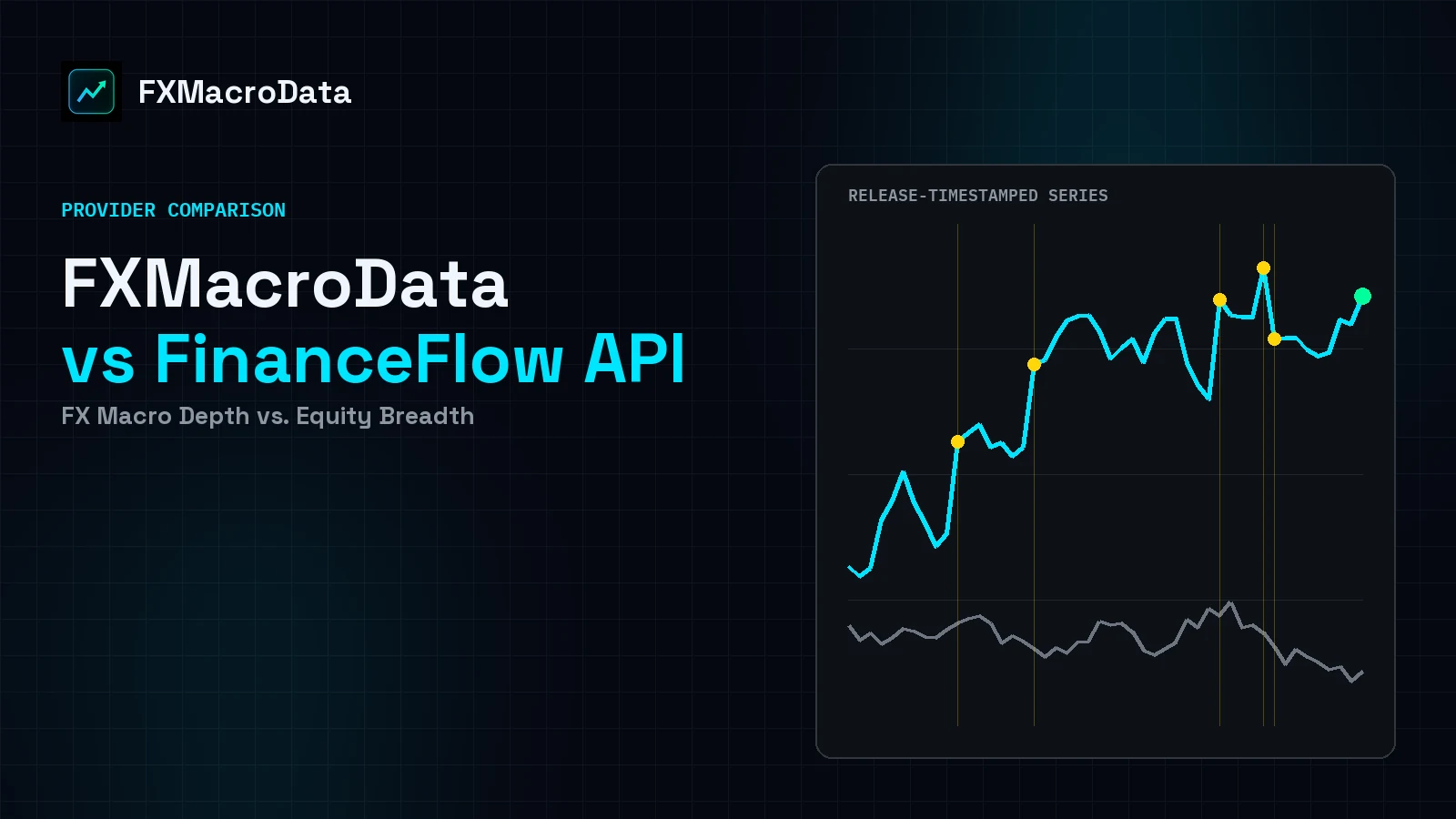
For FX traders building systematic strategies around macro releases, the difference between knowing when a number landed and merely knowing the date it was published is the difference between a usable and an unusable backtest. FinanceFlow API advertises a 1–2 minute refresh for macro indicators and bonds — a competitive update speed — but it does not document second-level publication timestamps for each release.
FXMacroData stores a announcement_datetime field for every historical release — the precise UTC timestamp, typically accurate to the second, at which the official figure was announced. New releases are typically available within seconds of official publication, which FXMacroData measures publicly. For event-study backtesting — measuring how far EUR/USD moved in the 60 seconds following a CPI print — second-level precision is the minimum requirement. Date-level resolution makes that analysis impossible.
# Fetch EUR inflation history with second-level announcement timestamps
curl -H "X-API-Key: YOUR_API_KEY" "https://api.fxmacrodata.com/v1/announcements/eur/inflation"
{
"data": [
{
"date": "2025-02-01",
"val": 2.3,
"announcement_datetime": 1742378402
},
{
"date": "2025-01-01",
"val": 2.5,
"announcement_datetime": 1740477601
}
]
}The same pattern — same three fields, same second-level announcement_datetime — applies to every indicator across every currency. For a backtesting pipeline, that consistency means one fetch utility and one data model regardless of the indicator or currency being tested.
Watching a euro area inflation print on each API
FinanceFlow: request budget
Standard ($25/month) allows 10,000 requests a month at 60 a minute; a 15-indicator, 10-currency, three-times-daily check needs 13,500.
FinanceFlow: refresh only
Macro indicators refresh every 1-2 minutes, but publication-time precision for each EUR inflation release is not documented.
FXMacroData: EUR row
/v1/announcements/eur/inflation stores the official announcement_datetime to the second, typically available within seconds of official publication.
EUR/USD 60-second window
Measure EUR/USD in the 60 seconds after the print from the stored timestamp, inside a 1,000,000-request monthly allowance.
Takeaway: FinanceFlow's refresh speed is competitive; an event study also needs the documented release second and enough request budget to watch every currency.
Central Bank Coverage
FinanceFlow API has no dedicated central bank feature set. Its macro indicators endpoint covers PMI, GDP, and similar aggregates, but there is no central-bank press release feed and no currency-scoped policy rate timeline that explicitly marks each rate decision and its corresponding announcement timestamp.
FXMacroData treats central bank data as a primary product surface. The policy rate endpoint returns the full rate history for every covered central bank with second-level announcement timestamps for each decision. The central-bank press release endpoints give developers programmatic access to the communications that contextualise rate moves. For an FX analyst building a model of central bank divergence — the primary driver of long-run currency trends — this depth is not a minor feature; it is the core of the use case.
MCP Server and AI Agent Integration
FXMacroData ships an official Model Context Protocol (MCP) server that exposes timestamped official-source macro releases, macro indicator queries, FX spot rates, COT positioning data, and the release calendar as callable tools for AI agents. Claude, ChatGPT, Cursor, and any other MCP-compatible assistant can directly query FXMacroData's data within a conversation or an automated pipeline — no custom integration glue required. An agent can ask: "What is the current AUD cash rate and when was it last changed?" and receive a structured, grounded answer from live data.
FinanceFlow API does not list an MCP server. Developers who want to integrate FinanceFlow data into an AI agent workflow must build their own tool wrapper around the REST API. That is a solvable engineering problem, but it is additional work with no off-the-shelf solution.
MCP Integration for FX Macro Agents
AI agents connected to FXMacroData's MCP server can ground macro narratives in live structured data — policy rate histories, inflation trajectories, COT positioning, upcoming release schedules — without writing a single line of API integration code. For analysts building LLM-powered FX research tools, this out-of-the-box capability is a meaningful time saving.
Developer Tools and Documentation
FinanceFlow API invests in traditional developer tooling: a GitHub-hosted documentation repository, Postman collections for all endpoint families, and SDKs for Python, PHP, and JavaScript. For developers who are already comfortable with Postman-driven exploration and prefer a library wrapper, these tools lower the initial integration friction.
FXMacroData's API follows a clean, predictable REST JSON pattern — /v1/announcements/{currency}/{indicator} — that works with any HTTP client, with official Python and JavaScript SDKs available. Authentication is a single X-API-Key header. The inline documentation at /api-data-docs covers every currency and indicator with example responses. A GraphQL interface is available for developers who prefer flexible querying, and Server-Sent Events (SSE) are available for real-time push when a new release prints.
Neither approach is objectively superior — they reflect different design philosophies. FinanceFlow provides more scaffolding for initial discovery; FXMacroData provides a simpler, more consistent API surface that requires less scaffolding once you understand the {currency}/{indicator} model.
Interactive Dashboard
FinanceFlow API is a developer-facing data product. There is no interactive analytics dashboard for non-developer users. Data exploration happens through the API, the SDKs, or the Postman collections. For a development team building its own dashboard on top of the data, this is entirely appropriate. For a macro analyst who wants to explore indicator trends, compare currencies, and share charts with colleagues without writing code, this is a gap.
FXMacroData includes a full-featured interactive dashboard covering Market Summary, the FX Dashboard, the Release Calendar, FX Sessions, CFTC COT positioning, precious metals, and bond yields. The same data that powers the API also powers the dashboard, so what analysts see in the UI is precisely what the API returns. A portfolio manager or strategist can use the dashboard directly, and the developer on the same team can pull the same data programmatically through the API or MCP server.
When FinanceFlow API Is the Right Choice
FinanceFlow Is a Strong Fit When You Need
- Access to 511,000+ global stock tickers with real-time pricing, income statements, balance sheets, and cash flow data
- SEC filing data (10-K, 10-Q, earnings) as part of a broad equities research platform
- A single API covering equities, bonds, commodities, and macro indicators for a general-purpose financial data aggregation project
- Government bond yields across 50+ countries for fixed-income-oriented work that does not require FX-specific macro depth
- Cost-effective access to broad financial data at $25–$50/month if request volumes fit the monthly cap
Recommendation and Verdict
For FX traders and macro analysts whose workflow centres on central bank decisions, currency-scoped indicator trends, COT positioning, and event-study backtesting, FXMacroData is purpose-built for that use case. The second-level announcement timestamps, the full central bank rate history with decision-date precision, the 1,000,000-request monthly allowance, and the MCP server for AI agents are all features that exist in FXMacroData specifically because FX macro traders need them. The interactive dashboard means non-developer team members can access the same data without writing a single query.
For developers building equity-focused or broad financial data platforms — stock screeners, portfolio trackers, SEC filing integrations, general-purpose financial aggregators — FinanceFlow API is a credible option. Its 511K-ticker coverage is a genuine strength that FXMacroData does not attempt to match, and the $25/month entry price is competitive for light usage. The request cap constraints are worth modelling before committing; a systematic pipeline can exhaust the Standard plan's 10,000 monthly budget faster than expected.
The two products share an overlap in macro indicators, economic calendars, and government bond yields, but they approach these features from opposite directions. FinanceFlow bolts macro data onto an equities platform. FXMacroData was designed from the ground up to serve the FX macro workflow at the depth and precision that systematic FX strategies demand. For that use case, the choice is clear.
Get Started with FXMacroData
- Browse the full 22-currency indicator catalogue at /api-data-docs
- Explore the interactive dashboard to see macro data across currencies without writing any code
- Subscribe and get your API key at fxmacrodata.com/subscribe
- Already have a key? Try the EUR inflation endpoint or the USD policy rate endpoint to see the second-level timestamp format in action
