Hermes Agent can help you maintain an FX research journal that connects each hypothesis to dated FXMacroData evidence. Connect its remote MCP client, write a pre-release view, and review that view after new observations arrive. Use memory for durable preferences and a reusable skill for the research procedure, while keeping changing market evidence in dated notes.
A trading journal preserves what you believed before the outcome became obvious. For USD/JPY, connect the Federal Reserve and Bank of Japan policy context to a conditional currency view. A later review should identify which observation changed that view, preserving the original thesis.
Hermes Agent is Nous Research's personal-agent product, with tools, memory, reusable skills and scheduling. It is distinct from the Hermes language-model family discussed in the Hermes model bot guide. This walkthrough uses the agent's research workflow and its documented remote MCP connection.
Prerequisites
- An installed Hermes Agent, a configured model provider and one successful ordinary conversation.
- FXMacroData access and an API key available securely to Hermes.
- A private research directory and a declared timezone for your reviews.
- A working Hermes gateway and continuously available host if you want scheduled tasks.
1. Define what each journal entry must preserve
Make the first entry narrow: a USD/JPY policy-context review, with the evidence available at a stated cutoff. Include relevant US policy-rate and Japanese policy-rate observations, plus confirmed events from the release calendar. Name the mechanism linking those inputs to the pair, and record contrary evidence.
| Layer | Keep here | Review rule |
|---|---|---|
| Dated research entry | Retrieved observations, cutoff, source fields, thesis and invalidation conditions. | Keep the original entry; append the later assessment. |
| Hermes memory | Preferred pairs, timezone, output format and research constraints. | Refresh preferences deliberately; retrieve changing market data again. |
| Reusable skill | The reviewed sequence of retrieval, validation and interpretation. | Inspect changes before reusing the procedure. |
| Execution system | Executable quotes, exposure limits, approvals and order status. | Validate separately from the research journal. |
Daily FX and reference OHLC data can describe historical context. They are not executable bid/ask quotes and cannot establish release-time slippage or whether an order would have filled.
Connection map
Give evidence, the journal and memory separate roles
- 01Your research request
Set the pair, cutoff, journal location and conditions to evaluate.
- 02FXMacroData MCP
Hermes retrieves bounded observations and retains their source context.
- 03Dated journal entry
Save the original evidence and conditional USD/JPY thesis together.
- 04Appended review
Compare new evidence with the original conditions and record the assessment.
Durable memory holds your preferences; a reviewed skill holds the procedure. Changing observations belong in dated entries and must be retrieved again.
2. Connect the remote MCP server
Follow the official Hermes installation route, run hermes setup or hermes model, and confirm a normal chat works. MCP support ships with the standard installation. Merge the following into ~/.hermes/config.yaml, leaving your other settings intact:
mcp_servers:
  fxmacrodata:
    url: "https://mcp.fxmacrodata.com"
    headers:
      Authorization: "Bearer ${FXMD_API_KEY}"
Make the key available through your protected credential environment. Hermes documents variable substitution in remote headers, so the configuration need not contain the raw secret. Alternatively, use auth: oauth instead of the static header and complete hermes mcp login fxmacrodata through the supported authorization flow.
Start a fresh session or use /reload-mcp, inspect tools with hermes mcp configure fxmacrodata, and request one small result. The actual returned data is the acceptance check. Configure only the tools the journal needs, using the server's discovered names.
MCP lets Hermes select data tools during a conversation. REST lets your own server-side code retrieve and validate a bounded response. The Hermes messaging gateway carries conversations and scheduled delivery; it is a separate surface from the FXMacroData connection. See the MCP access guide for the data service's authentication.
3. Write the hypothesis before the outcome
Record an explicit decision cutoff and separate facts from interpretation. An observation's reference period is different from its publication time. For a historical exercise, use only information demonstrably available by the cutoff; a current revised value may not be the value known then. Leave an unknown original publication time unknown.
Reader example: pre-release journal prompt
Create a dated USD/JPY research entry using FXMacroData. State the UTC cutoff, retrieved observations, units, reference periods and sources. Identify the next confirmed policy-related catalysts. Explain the rate-context mechanism, give the strongest counterargument, and define evidence that would weaken the thesis. Keep facts separate from interpretation. Save this as the pre-release entry, preserving its original text for later review.
A useful entry contains a falsifiable condition. For example, your policy-divergence explanation might weaken if the next published evidence points toward a different relative policy path. That is a conditional research scenario, not a prediction that a particular price must move in one direction.
Illustrative output
Place the original thesis beside its later assessment
Preserved USD/JPY thesis
Record the relative-policy mechanism, evidence cutoff, source links and a condition that would weaken the explanation. Preserve the entry's original wording.
Changed and unchanged evidence
A separate assessment identifies the new observations and explains which original conditions they strengthen, weaken or leave unresolved.
One reviewable improvement
Keep the source checks that worked and propose a specific procedural change to inspect. Store a stable preference only when it is useful across future entries.
Read the preserved thesis before the review. An assessment should answer the question originally asked, with changing evidence kept visible.
4. Review the outcome and keep memory useful
A second scenario is an US inflation review. Keep actual, prior and consensus as separate fields. A consensus surprise requires a matching forecast issued before publication, with the same units and horizon. An official projection or model-generated estimate is a different object. If a matching consensus is unavailable, discuss the observation's change without manufacturing a surprise.
Reader example: after-publication review prompt
Retrieve the relevant new FXMacroData observations and append a review to my original USD/JPY entry. Quote the original thesis conditions, identify which inputs changed, and explain whether the evidence strengthened or weakened each condition. Distinguish actual, prior and any matching ex-ante consensus. Do not infer a publication time or treat a scheduled event as released. List unresolved evidence and one change to the research procedure worth testing.
Hermes maintains bounded MEMORY.md and USER.md stores under ~/.hermes/memories/. They are loaded at session start. Ask it to save durable preferences explicitly and check that a memory write occurred. Use /new at natural task boundaries so the next session loads updated memory; session_search can recover previous discussions.
Keep observations in the dated journal, preferences in memory, and the repeatable workflow in a reusable skill. Review proposed skills before adopting them, particularly their data windows, forecast comparisons and file-writing behavior.
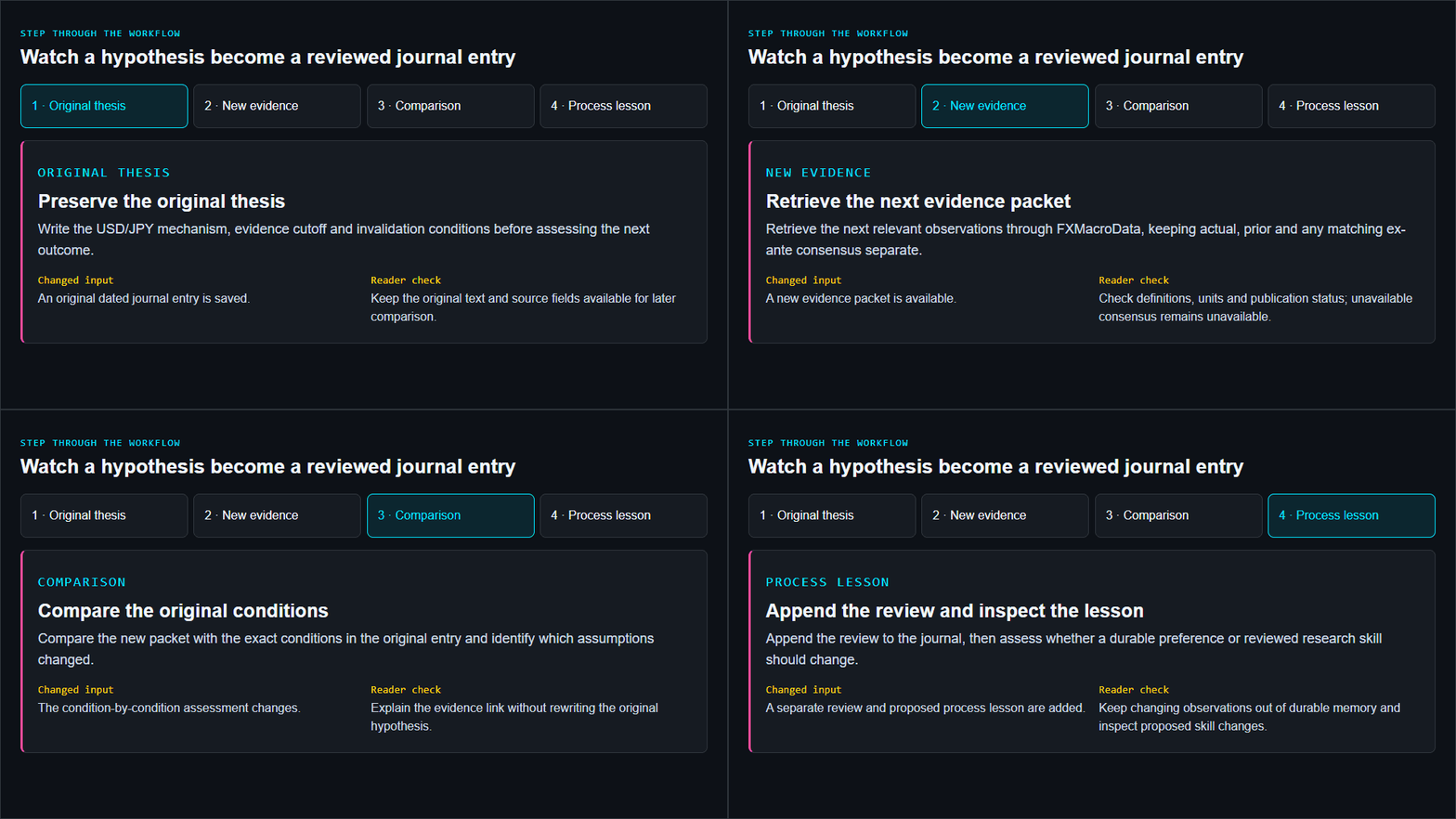
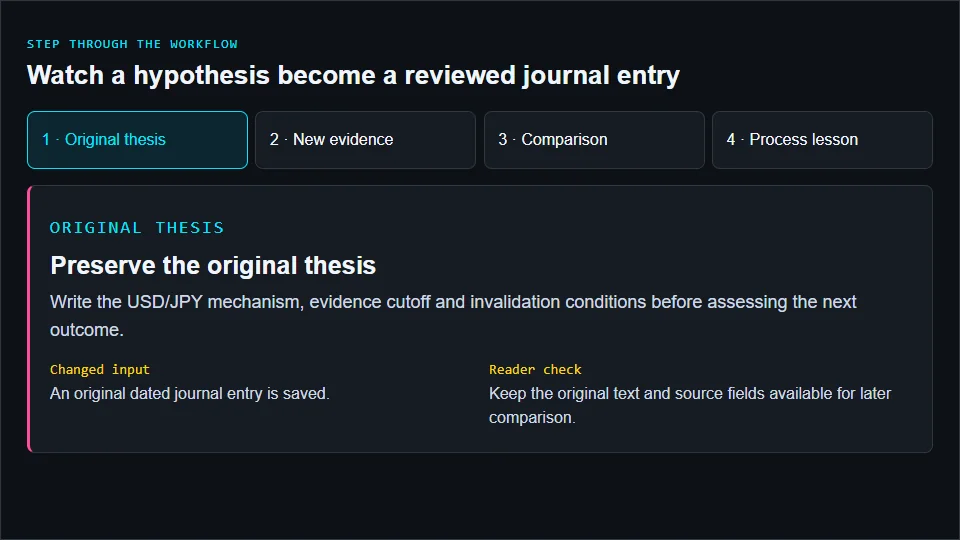
Step through the workflow
Watch a hypothesis become a reviewed journal entry
Original thesis
Preserve the original thesis
Write the USD/JPY mechanism, evidence cutoff and invalidation conditions before assessing the next outcome.
- Changed input
- An original dated journal entry is saved.
- Reader check
- Keep the original text and source fields available for later comparison.
New evidence
Retrieve the next evidence packet
Retrieve the next relevant observations through FXMacroData, keeping actual, prior and any matching ex-ante consensus separate.
- Changed input
- A new evidence packet is available.
- Reader check
- Check definitions, units and publication status; unavailable consensus remains unavailable.
Comparison
Compare the original conditions
Compare the new packet with the exact conditions in the original entry and identify which assumptions changed.
- Changed input
- The condition-by-condition assessment changes.
- Reader check
- Explain the evidence link without rewriting the original hypothesis.
Process lesson
Append the review and inspect the lesson
Append the review to the journal, then assess whether a durable preference or reviewed research skill should change.
- Changed input
- A separate review and proposed process lesson are added.
- Reader check
- Keep changing observations out of durable memory and inspect proposed skill changes.
5. Schedule a bounded review, with a REST fallback
Once the journal procedure works manually, schedule a modest check for new evidence. This example uses Hermes's documented recurring interval syntax:
hermes cron create "every 2h" \
  "Use FXMacroData to review my dated USD/JPY journal. Retrieve bounded new evidence, state the cutoff, and append changes without rewriting the original hypothesis. If nothing materially changed, respond with only [SILENT]." \
  --name "USD JPY journal review"
The gateway must remain running. Check hermes cron list and hermes cron status, and verify the next run and delivery target. Jobs use fresh sessions, so specify the journal location and essential procedure in the saved prompt or attach your reviewed skill. Hermes's documented scheduler ticks every 60 seconds; this workflow supports periodic research rather than precise release-time execution. [SILENT] suppresses unchanged successful delivery.
If application-owned validation is needed, retrieve a small REST response on your trusted server or workstation:
curl --fail --silent --show-error \
  -H "X-API-Key: ${FXMD_API_KEY}" \
  "https://api.fxmacrodata.com/v1/announcements/jpy/policy_rate?limit=20&offset=0"
REST is server-side only; keep credentials out of public browser code. List endpoints default to 20 rows, allow limit up to 100, and paginate with offset until pagination.has_more is false. Stop once the intended review window is complete, and retain timestamps and source fields in the evidence record.
6. Evaluate whether the journal improves your process
- A real tool call succeeds for both required currencies.
- The original hypothesis remains available beside the later assessment.
- Every numerical claim traces to retrieved evidence or an explicit calculation.
- Unknown timestamps, missing consensus and failed retrievals remain visible.
- Scheduled runs reach the intended destination, and broker actions have separate controls.
Illustrated walkthrough
Preserve and review a Hermes FX research journal
Read the walkthrough transcript
- Preserve the original thesis: Write the USD/JPY mechanism, evidence cutoff and invalidation conditions before assessing the next outcome. Reader check: Keep the original text and source fields available for later comparison.
- Retrieve the next evidence packet: Retrieve the next relevant observations through FXMacroData, keeping actual, prior and any matching ex-ante consensus separate. Reader check: Check definitions, units and publication status; unavailable consensus remains unavailable.
- Compare the original conditions: Compare the new packet with the exact conditions in the original entry and identify which assumptions changed. Reader check: Explain the evidence link without rewriting the original hypothesis.
- Append the review and inspect the lesson: Append the review to the journal, then assess whether a durable preference or reviewed research skill should change. Reader check: Keep changing observations out of durable memory and inspect proposed skill changes.
Measure how often the review catches a stale assumption, how much preparation time it saves, and whether explanations remain consistent with their evidence. Evaluate any trading strategy separately with costs and out-of-sample data. Your finished journal should preserve what you knew, explain what changed, and improve a procedure you can inspect. Compare adjacent personal-agent approaches in the AI trading guides, and use the API client patterns guide for application reliability.