
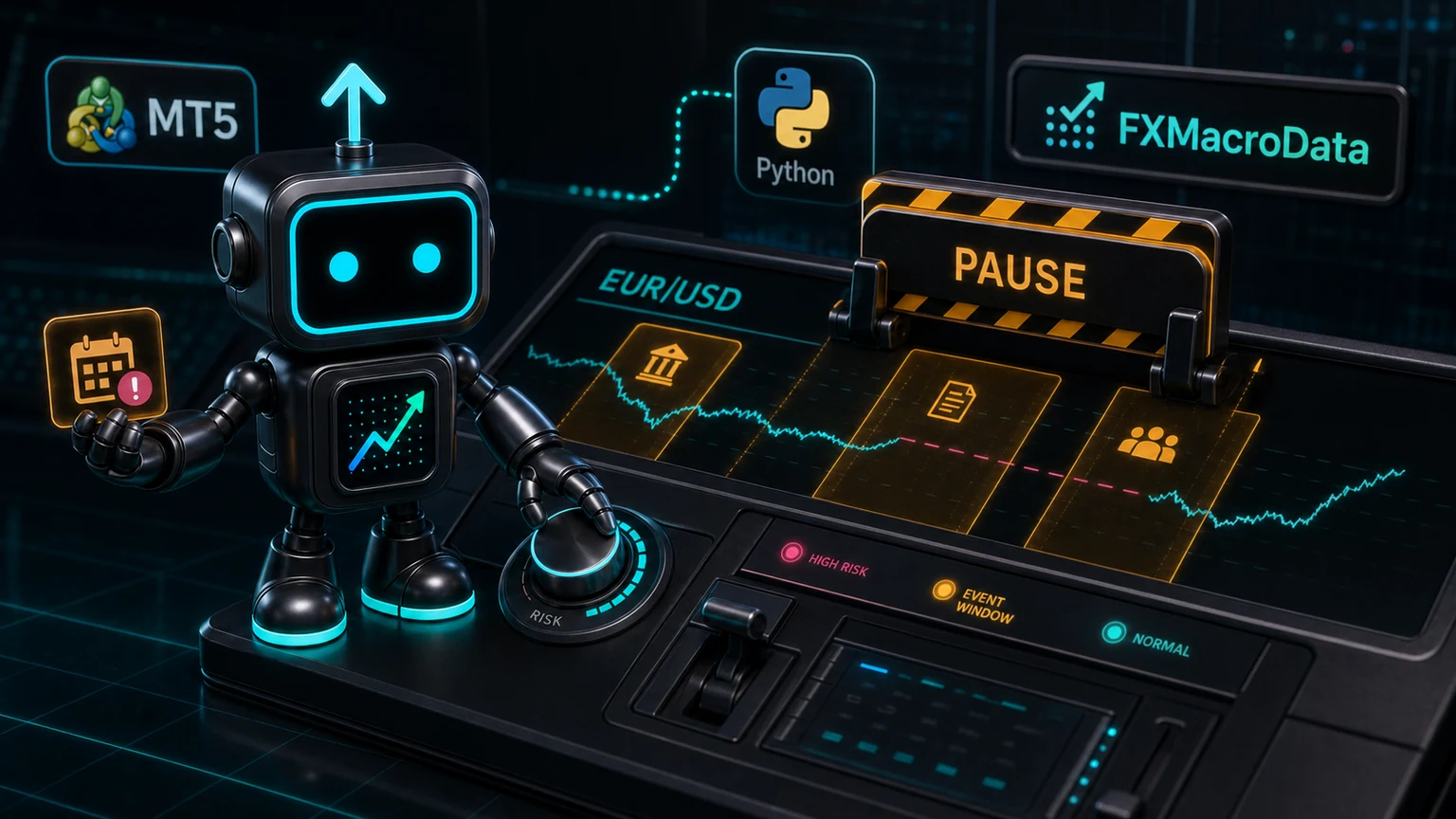
MetaTrader 5 Python integration lets Python scripts connect to the MetaTrader 5 terminal, retrieve market data, inspect account state, and work with trading functions. FXMacroData adds the macro context that MT5 price data does not provide by itself: release calendars, announcement history, session state, and indicator history for FX trading workflows.
This guide focuses on event filtering, not automated order placement. The same pattern can support research dashboards, strategy diagnostics, and human-reviewed alerts before any live trading workflow is considered.
Fit
Use this for
MT5 research scripts, event filters, pre-trade checks, and release-risk overlays for FX pairs.
MT5 Python works best when
The terminal remains the source for broker-side symbols and bars while macro data comes from a separate evidence API.
Keep separate
Model commentary, broker credentials, order sending, and risk-limit changes should not share one uncontrolled path.
Why MT5 Python Fits Event Filters
MetaTrader 5 Python can initialize a terminal connection and pull rates or ticks from the terminal. That is useful for pairing broker-visible price data with an external macro calendar. The price data tells you what happened on the chart; FXMacroData tells you whether a release window or central-bank event should change how you interpret it.
For example, a EUR/USD strategy might behave differently before Non-Farm Payrolls, during a Federal Reserve policy-rate announcement window, or after a high-surprise US CPI print.
What Changes for an MT5 Trader
The MT5 terminal already gives a trader a fast view of symbols, bars, ticks, and account state. What it does not automatically answer is whether the next candle is happening inside a known macro hazard zone. That distinction matters because a strategy that is sensible during normal liquidity can become a different strategy around a high-impact release.
With FXMacroData attached, the script can stop treating every signal as equally actionable. A long setup five minutes before a major USD print can be labelled "wait", while the same setup during a quieter session can proceed to the normal strategy review. That is a risk-control improvement, not a prediction engine.
Trader scenario
A EUR/USD signal appears during the New York handover. The MT5 script checks the next USD event window before anything else. If a release is close, the output is not a trade recommendation; it is a clear pause reason with the event name, time window, pair, and source path.
This keeps the human workflow clean. The trader does not need to remember every calendar event while scanning charts, and the script does not need authority to trade. It simply makes the event risk visible at the exact moment a setup is being considered.
Workflow Shape
1. Connect
Initialize MetaTrader 5 Python and load recent bars for the target pair.
2. Fetch
Call FXMacroData for upcoming events and recent announcement history.
3. Gate
Mark pre-event and post-event windows as blocked or human-review required.
4. Report
Return a clear reason: pair, event, time window, source path, and action state.
MT5, REST, MCP, or AI?
| Layer | Owns | Use it for |
|---|---|---|
| MetaTrader 5 Python | Terminal connection, symbols, ticks, bars, and broker-side state. | Reading market data and attaching the event filter to local strategy scripts. |
| FXMacroData REST | Calendar, announcement, FX, session, and macro-history evidence. | The production data path for event filters. |
| FXMacroData MCP | Hosted tool discovery for MCP-compatible assistants. | Explaining, debugging, or generating research code around the workflow. |
| AI model | Natural-language explanation. | Summaries after the deterministic event gate has already made the data check. |
Step 1: Read MT5 Bars
Install the official MetaTrader5 Python package, start the terminal, and initialize the connection before requesting rates.
pip install MetaTrader5 pandas requestsimport MetaTrader5 as mt5
import pandas as pd
if not mt5.initialize():
raise RuntimeError(f"MT5 initialize failed: {mt5.last_error()}")
rates = mt5.copy_rates_from_pos("EURUSD", mt5.TIMEFRAME_M15, 0, 200)
bars = pd.DataFrame(rates)
bars["time"] = pd.to_datetime(bars["time"], unit="s", utc=True)Step 2: Fetch Macro Events
Fetch the macro calendar from the production API. Keep API keys in environment variables and use header-based API-key examples in public docs.
import os
import requests

def fxmd(path: str, **params) -> dict:
    headers = {"X-API-Key": os.environ["FXMD_API_KEY"]}
    url = f"https://api.fxmacrodata.com/v1{path}"
    response = requests.get(url, params=params, headers=headers, timeout=20)
    response.raise_for_status()
    return response.json()

usd_calendar = fxmd("/calendar/usd")
curl -H "X-API-Key: YOUR_API_KEY" "https://api.fxmacrodata.com/v1/calendar/usd"
curl -H "X-API-Key: YOUR_API_KEY" "https://api.fxmacrodata.com/v1/announcements/usd/inflation"
curl -H "X-API-Key: YOUR_API_KEY" "https://api.fxmacrodata.com/v1/market_sessions"Step 3: Build the Event-Risk Gate
The first version should answer one question: is this pair inside a blocked release window? Keep the output simple enough for a strategy or human reviewer to consume.
from datetime import timedelta
import pandas as pd

def in_event_window(now, events, before=timedelta(minutes=60), after=timedelta(minutes=30)):
    for event in events.get("data", []):
        ts = pd.to_datetime(event["announcement_datetime"], unit="s", utc=True)
        if ts - before <= now <= ts + after:
            return {
                "blocked": True,
                "event": event.get("release"),
                "source": "/v1/calendar/usd",
            }
    return {"blocked": False, "source": "/v1/calendar/usd"}
Use that result as a read-only signal first. In a live system, any transition from "blocked" to "order allowed" should go through the same deterministic risk layer as every other trading control.
What the Filter Should Tell the Trader
A useful event filter is specific. "High risk" is not enough. The trader needs to know whether the block is caused by timing, missing data, a high-impact release, or a deliberate session rule.
| Output | Why it matters |
|---|---|
| Action state | Clear values such as allowed, blocked, or review_required keep the strategy path deterministic. |
| Event context | The event name, currency, and release window explain why the signal changed. |
| Source path | The trader or reviewer can trace the decision to the FXMacroData data surface used. |
| Expiry time | A pause should end at a defined time rather than becoming a vague manual override. |
Optional AI Explanation Layer
An AI assistant can explain why the gate blocked a setup, but it should not be the gate. If the host supports MCP, connect it to https://mcp.fxmacrodata.com so it can inspect FXMacroData tools while helping with research.
{
  "servers": {
    "FXMacroData": {
      "type": "http",
      "url": "https://mcp.fxmacrodata.com",
      "headers": {"Authorization": "Bearer YOUR_API_KEY"}
    }
  }
}
Trading Guardrails
Minimum controls
- Start with read-only event flags, not order sending.
- Log every calendar response and the source endpoint used.
- Use UTC internally and convert only for display.
- Keep broker credentials outside model-visible prompts and transcripts.
- Require deterministic approval before any live order action.
Sources
